Tennessee, often celebrated for its country music and barbecue, conceals a geographical tapestry far more intricate and astonishing than its popular image suggests. From subterranean marvels to ancient mountains and rivers that defy convention, the state's landscape is a masterclass in natural paradoxes. It is a place where the earth itself can turn to liquid, where lakes are born overnight from seismic violence, and where entire ecosystems thrive in conditions that mimic distant lands. This is not merely a state with interesting features, it is a geological plot twist, a testament to the world's capacity for surprise, hidden in plain sight.
Subterranean Secrets: A World Beneath Tennessee's Surface
Tennessee leads the nation with almost 12,000 caves, roughly 20 percent of all known U.S. caves. About 140 new ones are mapped annually, with the Bald Knob Quadrangle alone containing 345. From Ruby Falls’ 145 foot underground waterfall to the vast Lost Sea, Tennessee holds a hidden world.
The Lost Sea, America's largest underground lake beneath Sweetwater, was discovered in 1905 by 13 year old Ben Sands. Divers have mapped 13 acres, but its edges remain undiscovered, with explorers reporting a massive, lightless void beyond reach.
Sands' discovery was initially dismissed, as rising water sealed the entrance for 50 years. He had tested the cavern's immense size, hearing splashes but no echoes. Rediscovered in the 1960s, Sands himself took the first official boat ride across his childhood find.
Rainbow trout, introduced to the Lost Sea, grew to outrageous sizes, losing color and 20 percent of their vision within months. This is a biological reaction to permanent darkness, not evolution, as the lake lacks spawning conditions.
Craighead Caverns also hosts anthodites, absurdly rare crystal cave flowers. These needle thin formations, found in few global locations, are so fragile a touch can shatter thousands of years of growth, making them the cavern's true prize.
Rumbling Falls Cave contains America's second biggest chamber, the Rumble Room, spanning 5 acres with a 360 foot ceiling. Reaching it involves a 68 foot vertical shaft, two waterfalls, and 2,000 feet of passage barely a foot wide. A low frequency vibration from a 100 foot underground waterfall echoes throughout.
Blue Spring Cave near Sparta, initially deemed short, revealed over 40 miles of passage after cavers pushed through a tight, air blowing 12 inch hole in 1989, making it one of the state's longest systems.
Deep within Blue Spring Cave, perfectly preserved Pleistocene footprints of Ice Age jaguars, weighing up to 500 pounds, were found over a mile deep. These cats navigated underground darkness tens of thousands of years ago.
Cumberland Caverns' Hall of the Mountain King, a 600 foot chamber, houses a massive crystal chandelier salvaged from a Brooklyn theater. Hauled 300 feet underground in the 1980s, it created a concert hall. Despite 99 percent humidity, the crystal has glowed for over 40 years, preserved by the cave's constant 56 degree Fahrenheit temperature.
The Volcano Room, 333 feet under Cumberland Caverns, served for nine years as PBS's Bluegrass Underground recording studio. Its limestone walls create zero floor noise, but 99 percent humidity causes wooden instruments to swell, offering perfect acoustics under impossible conditions.
The Earth's Tremors: Reshaping the Volunteer State
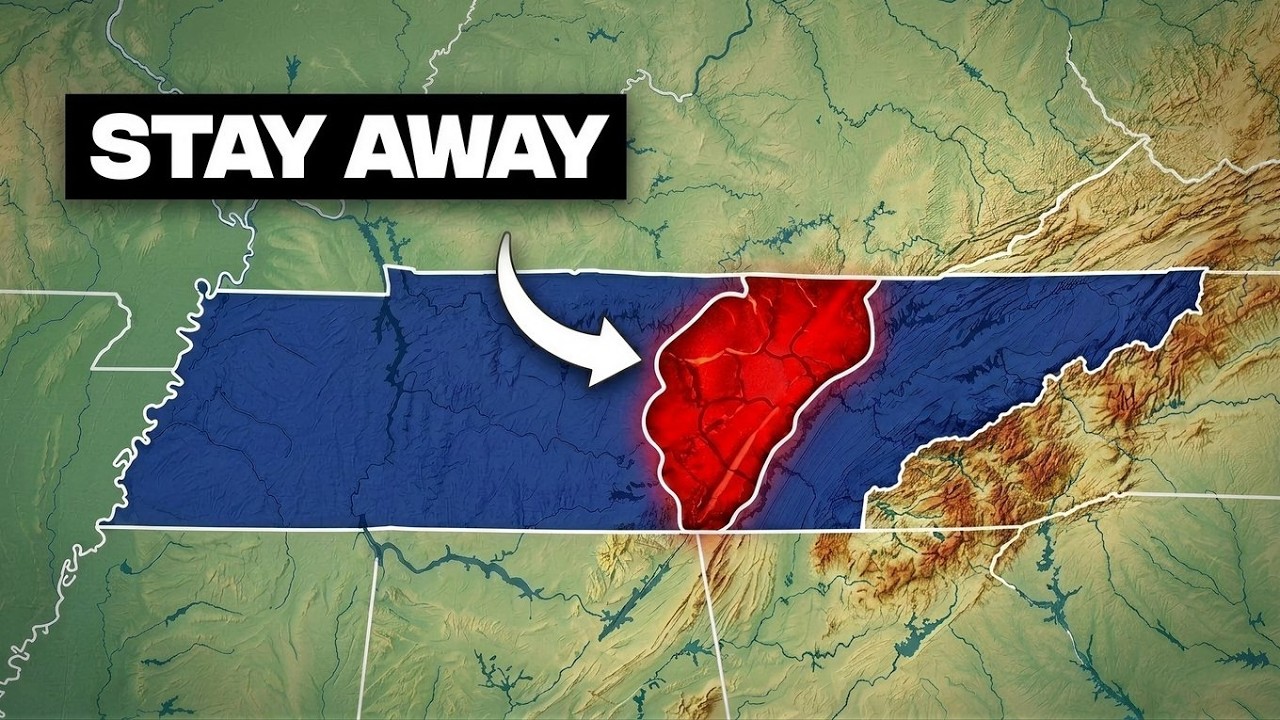
The New Madrid earthquakes of 1811-1812 rocked northwest Tennessee, with an impact zone 10 times bigger than San Francisco's 1906 quake. The East's solid bedrock transmitted seismic energy across half the continent, devastating a forest to form a new lake. Jared Brooks recorded 1,874 shocks.
On February 7, 1812, the Tiptonville Dome's upward arch under the Mississippi River temporarily dammed it, forcing a retrograde current. Water surged upstream at a fast horse's speed for over a mile, creating waterfalls that swallowed 30 boats and permanently altering the river's geography.
The 1811 New Madrid quake's vibrations traveled over 1,000 miles, ringing church bells in Boston, stopping clocks in South Carolina, and waking President James Madison. Nearly a million square miles felt this most powerful seismic event in Eastern American history.
During the quakes, liquefaction turned ground across an area the size of Jamaica into liquid. Fissures opened, shooting pressurized sand and water 100 feet into the air, even launching 30 pound rocks. West Tennessee remains pockmarked with these scars, visible from the air.
Reelfoot Lake, Tennessee's only large natural lake, formed overnight during the New Madrid sequence. Ground dropped up to 20 feet, and the Mississippi flooded the basin, drowning a forest. Submerged stumps still stand, a monument to the earth's sudden shift.
The New Madrid seismic zone is underlain by the Reelfoot Rift, a crack formed 750 million years ago when Rodinia pulled apart. This unhealed weakness causes 200 quakes annually. The 1811-1812 fault structure remains active, capable of future devastation.
Reelfoot Lake, spanning 15,000 acres with an average depth of just 5.5 feet, is a flooded graveyard of the 1812 earthquake's forest. Bald cypress trees grow from the water, and original stumps snag boat propellers. Alligators are now appearing, transforming the lake into a more Southern ecosystem.
In 1992, tree ring analysis of Reelfoot's ancient bald cypresses showed a growth surge beginning in 1812. Survivors thrived, while others showed stunted growth from violent shaking. These cypresses, living over a thousand years, provide a seismic timeline beyond written history.
The New Madrid seismic zone is underlain by the Reelfoot Rift, a crack formed 750 million years ago when Rodinia pulled apart. This unhealed weakness causes 200 quakes annually.
Majesty of the Appalachians: Ancient Peaks and Unseen Life
The Great Smoky Mountains draw over 12 million visitors annually, double Zion or Grand Canyon. This popularity partly stems from a no entry fee guarantee from Newfound Gap Road's construction. In 2023, Park It Forward introduced parking tags for stays over 15 minutes, maintaining the "no fee" mandate while generating revenue.
The Smokies' iconic haze is not smoke or fog, but scattering from volatile organic compounds released by millions of trees, primarily oaks and poplars, coping with heat stress. The Cherokee called it Shakane, land of blue smoke. Natural visibility can reach 112 miles, now averaging 46 miles after pollution reduction.
The Smokies house over 130 native tree species, more than Europe combined, making it the most biodiverse forest in the temperate world. The All Taxa Biodiversity Inventory has cataloged over 22,800 species, including 1,000 new to science, and estimates 80,000 to 100,000 more are undiscovered. It is the salamander capital of the world.
The park protects 187,000 acres of old growth forest, the largest untouched tract in the eastern U.S., with a quarter being over 500 years old. The highest peaks host the world's largest virgin red spruce forest. Receiving over 85 inches of rain, these cloud forests are technically temperate rainforests, absorbing water directly from mist 65 percent of the year.
Every May, thousands of Photinus carolinus fireflies in Elkmont synchronize their light pulses, a phenomenon once thought impossible in the Western Hemisphere. Documented in 1995 after a resident corrected scientists, the event now draws global attention, with over 20,000 applicants for just 120 vehicle passes per night in 2025.
The Great Smoky Mountains, the world's salamander capital, host 31 species, 24 of which are lungless. The combined biomass of these amphibians exceeds the total weight of the park's 1,900 black bears, and likely all other birds and mammals. Salamanders are the park's most abundant, yet overlooked, vertebrate wildlife.
The Appalachian Mountains began forming 480 million years ago, predating bones. During Pangaea, they linked to Scotland's Highlands and Morocco's Atlas Mountains. Today's rounded ridges are from half a billion years of erosion, with core rock over a billion years old.
A 30 minute drive from the Smokies' base to the 6,643 foot summit of Kuwohi mimics a 1,000 mile northward journey. Southern hardwoods transition to boreal spruce fir forests, resembling Quebec. These "sky islands" harbor Ice Age relics, plants and animals isolated on peaks since glaciers retreated 10,000 years ago.
Tennessee's Liquid Labyrinths: Rivers Wild and Engineered
The Tennessee River defies convention, flowing southwest from Knoxville toward Alabama, then executing a massive U turn to flow almost due north. This northward stretch is longer than almost any major river in North America, caused by stream capture millions of years ago. It carved the 26 mile River Gorge, home to the treacherous Suck whirlpool.
The Duck River, a 284 mile marvel, is one of Earth's three most biodiverse rivers. Its waters contain 151 fish species, more than all of Europe, plus 56 freshwater mussels and 22 aquatic snails. National Geographic's 1 cubic foot project found more life in one riverbed section than in entire foreign systems. It is now one of America's top three most endangered rivers.
The Hatchie River, flowing 238 miles through West Tennessee, remains the last major lower Mississippi tributary untouched by human engineering. Unlike neighboring waterways, the Hatchie meanders through the state's largest forested floodplain. Natural flooding supports prehistoric biodiversity, including 11 catfish species, the most in North America.
The Tennessee Tombigbee Waterway, connecting the Tennessee River to the Gulf, required excavating 310 million cubic yards of Earth, surpassing the 268 million moved for the Panama Canal. Completed in 1984 for nearly $2 billion, it is the largest earthmoving project in US Army Corps of Engineers history, yet remains largely unknown.
Karst Country: Sinkholes, Springs, and Hidden Pathways
Virgin Falls, on the Cumberland Plateau, emerges from a cave, drops 110 feet, and disappears into another cave below. No visible stream feeds or carries it away. Dye tests show its water travels miles through a karst system before resurfacing as Big Spring on the Caney Fork River, making it the most geologically unusual waterfall in the eastern United States.
Grassy Cove in Cumberland County, 3 miles wide and 6 miles long, covering 5 square miles, is North America's largest sinkhole. Formed roughly 250 million years ago, it hides in plain sight, with State Route 68, a general store, church, and farms located within. Most residents are unaware they live in a crater.
All water in Grassy Cove drains into Mill Cave, traveling seven miles underground before resurfacing as the Sequatchie River's headwaters at Devilstep Hollow. Locals confirmed this connection by tossing corn shucks into the cove. Devilstep Hollow also contains ancient Native American mud glyphs and petroglyphs over a thousand years old.
Official maps show over 54,000 sinkholes in Tennessee, but geologists estimate the true number is closer to 270,000. Most are unmapped due to small size, but some counties average eight per square mile. Karst geology's soluble limestone leads to collapses, so AI and 3D lidar now predict new sinkhole formations.
Geological Grandeur: Plateaus, Arches, and Inverted Basins
The Cumberland Plateau, stretching 450 miles from West Virginia to Alabama, is Earth's longest hardwood forested plateau. In Tennessee, it rises 1,000 feet, capped by 300 million year old sandstone. Its sheer, forested base, an "impenetrable wall" to 1770s settlers, geographically reshaped America's westward expansion.
The Big South Fork region hides some of the East's most impressive natural arches. The Twin Arches complex features the South Arch, 103 feet tall with a 135 foot span, arguably the most massive in volume globally. These formations emerge suddenly from the Appalachian canopy.
Savage Gulf State Park's Great Stone Door is a 150 foot vertical crack in a sandstone ridge, a 10 foot wide natural staircase used by Native Americans and early settlers. Through the door, three massive gulfs drop 800 feet into 5 mile long gorges, a hidden geological masterpiece.
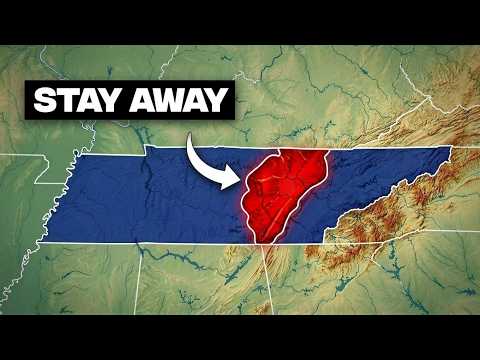
Between 300 and 400 million years ago, central Tennessee uplifted into a dome. Erosion collapsed its center faster than its edges, creating a topographic inversion. Today, the Nashville basin is a massive bowl encircled by the Highland Rim, exposing 450 million year old fossils from when Tennessee was a tropical seabed. Nashville is built inside a geological crater.
Between 300 and 400 million years ago, central Tennessee uplifted into a dome. Erosion collapsed its center faster than its edges, creating a topographic inversion.
Lines on the Land: Borders, Blunders, and Exclaves
Tennessee borders eight states: Kentucky, Virginia, North Carolina, Georgia, Alabama, Mississippi, Arkansas, and Missouri, tying with Missouri for the most neighbors. Its long, narrow shape, stretching 440 miles but averaging only 112 miles wide, allows it to cross the Midsouth, making it America's geographic crossroads.
Georgia has contested the Tennessee border for over 200 years. In 1818, surveyor James Camak placed the line one mile too far south, missing the Tennessee River by 200 feet. This sliver of land represents a billion gallon per day water surplus for Atlanta. The dispute remains, marked by petty actions like Chattanooga's mayor sending bottled water to Georgia.
Tennessee's northern border is jagged, reflecting 18th century surveying errors. In 1779, Dr. Thomas Walker veered 12 miles off course marking the 36°30′ parallel, blaming magnetic ore. Local legend suggests whiskey drinking farmers influenced the line. These errors led to an 1893 Supreme Court ruling in Bristol, running the state line down a street.
The Kentucky Bend, a 17.5 square mile exclave, is Kentucky land entirely surrounded by Tennessee and the Mississippi River. A surveying error caused this. As of 2020, nine people live there, accessing their home state by land only through Tennessee. Mail and schools are from Tennessee, a geographic anomaly never corrected.
Echoes of Deep Time and Extreme Weather
70 million years ago, West Tennessee was a seafloor, part of the Mississippi Embayment. At the Coon Creek Science Center, this ancient seabed perfectly preserves 70 million year old shells with original pearly gloss. With 600 documented species, it is a world class time capsule from when 40 foot mosasaurs roamed Tennessee waters.
In 2000, road construction near Gray, Tennessee, unearthed a Pliocene era sinkhole pond, nearly 5 million years old. This trap preserved over 38,000 specimens, including rhinos, alligators, and saber tooth cats. A prehistoric red panda, the only one found in the Americas, is a key biogeographic link to Eurasia. Most of this collage remains unexcavated.
On January 23, 1963, Waverly, Tennessee, plummeted from 54°F to -26°F, an 80° drop in under 24 hours. Kingston Springs reached -30°F, a state record. Middle Tennessee's geography allows Arctic air to flow south unobstructed, creating volatile, rapid climate swings.
Tennessee leads the nation in nocturnal tornadoes, with 46 percent occurring at night. This makes them exceptionally lethal, often striking while people sleep. Central Tennessee and northern Alabama form Dixie Alley, a modern tornado hotspot. These storms are frequently rain wrapped, making them invisible.
At 12:32 a.m. on March 3, 2020, an EF3 tornado carved a 60 mile path through Nashville, invisible in darkness. It killed five people in the city, and hours later an EF4 killed 19 more in Cookeville, with as little as one minute of warning. With $1.5 billion in damage, it was one of the costliest US tornadoes, striking while the city slept.
Power, Preservation, and Peculiar Ecosystems
In 1933, fewer than three percent of Tennessee Valley farms had electricity. The TVA then built 49 dams, creating over 11,000 miles of reservoir shoreline, more than all five Great Lakes combined. This power surge fueled the Manhattan Project's uranium facilities in Oak Ridge. In one decade, rural Tennessee became a high voltage engine of the nuclear age.
Middle Tennessee's cedar glades, on 500 million year old limestone, endure extreme swings: winter swamps, summer deserts. Only specialized plants, including 25 endemic species, survive. The Nashville breadroot and Tennessee coneflower (rediscovered in 1960, delisted 2011) are conservation icons of this unique ecosystem.
Roan Mountain's "balds" along the Tennessee, North Carolina border are open, grassy meadows instead of forest. The leading theory suggests Pleistocene megafauna, like mastodons, grazed them bare. Deep soil profiles confirm they are ancient grasslands, not fire cleared. The Roan Highlands' 1,000 acres are now maintained by goats mimicking these extinct grazers.
Tennessee, it turns out, is a geographical paradox, a state whose unassuming exterior belies a landscape brimming with geological plot twists, ecological marvels, and human stories etched deep into the earth. It challenges the conventional understanding of what a state can be, proving that the world is often stranger, wilder, and more complex than any textbook or map might suggest. The Volunteer State, far from being just a heartland of culture, is a vibrant testament to the planet's enduring capacity for the unexpected.