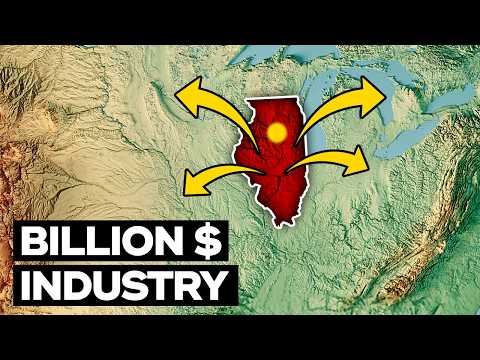
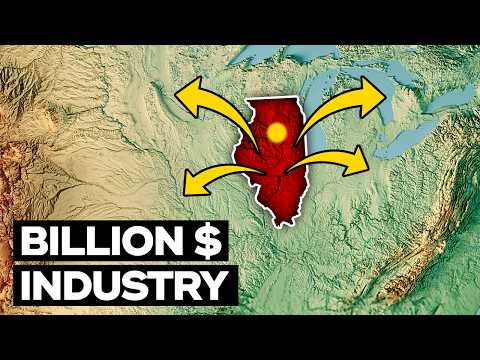
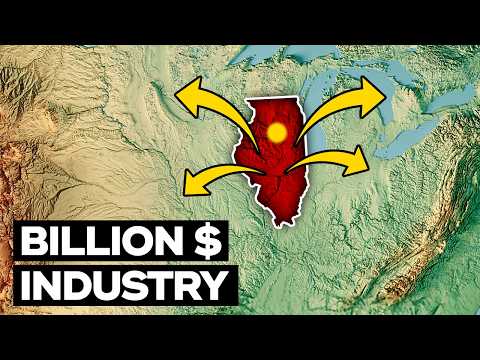
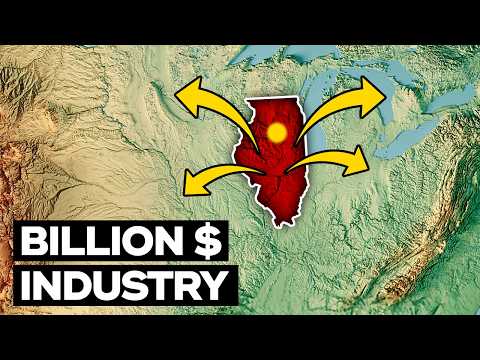
Imagine a quiet, rural town of 18,000 people in Illinois, a place most Americans have never heard of, yet it harbors a geological secret so profound it underpins the entire digital age. This is Ottawa, Illinois, and beneath its unassuming surface lies a deposit of nearly laboratory-grade quartz, 99.5 percent pure silicon dioxide, formed 450 million years ago when Illinois was submerged beneath a tropical sea. This isn't just any sand, it is the fundamental ingredient for your smartphone screen, the solar panels powering homes, and the silicon chips in your computer. Ottawa mines over 2.2 million tons of this invaluable resource every year, making it home to North America's largest silica production facility. The North American silica sand market, currently valued at $7.3 billion, is projected to surge to $13.3 billion by 2033, nearly doubling its worth. Illinois is not merely a Midwestern state, it is quietly assembling an unparalleled array of advantages, from ancient geological riches to cutting-edge technology, positioning itself as America's next economic superpower, a reality few have yet to grasp.
The Primal Sands of Power
The story of Illinois's hidden might begins 450 million years ago, a time when the land we now call Illinois lay beneath a shallow tropical sea, positioned near the equator. Over eons, the relentless action of waves and currents meticulously ground coastal quartz into perfectly uniform grains. These pristine grains settled, forming a thick blanket of sand that would eventually harden into the St. Peter sandstone, a geological formation so pure and homogeneous it requires minimal processing for industrial use. In some regions, this invaluable layer extends for hundreds of feet, an immense subterranean treasure.
The potential of this high-purity St. Peter sandstone was first recognized in the 1890s by miners near Ottawa. In 1894, the United States Silica Sand Company, now known as US Silica, opened its initial large-scale silica sand pits. By 1912, the burgeoning operations were shipping out 100 railroad cars of sand every single day, approximately 3,300 tons, primarily destined for Midwestern glass factories. This versatile sand became the foundation for countless everyday items: glass jars, bottles, laboratory equipment, and windows. The famous Ball Brothers, creators of the iconic Mason Jar, specifically sourced sand from this region to produce their distinctive blue-tinted canning jars. The demand was so immense that a 200-foot sand dune in Indiana, known as the Who's Your Slide, was entirely mined out by 1920, with 13.5 million tons of sand gone, much of it for Ball jars and plate glass due to its iron-rich composition, ideal for glassmaking. After this dune's disappearance, Ottawa's seemingly bottomless reserves took over, establishing Ottawa sand as the industry standard, literally serving as the reference material for cement strength tests and scientific research worldwide due to its consistent quality.
The 21st century has ushered in an even greater demand for Ottawa sand, transforming its role far beyond traditional glassmaking. This ultra-pure silica is now the unseen, critical ingredient of the digital age. It serves as the key feedstock for optical fiber, the robust glass in smartphones and solar panels, and the intricate world of semiconductor manufacturing. Consider this: much of the silicon that defines Silicon Valley literally originates from Illinois sand. The very properties that glassmakers prized a century ago, purity, heat resistance, and uniformity, are precisely what microchips and LCD displays demand today. Each grain can be melted to extract silicon for circuits or formed into the super-strong glass protecting your phone screen. The escalating demand from renewable energy initiatives and high-tech electronics has sent its value soaring. The North American silica sand market, valued at $7.3 billion in 2024, is projected to reach an astonishing $13.3 billion by 2033, nearly doubling in less than a decade. Ottawa is uniquely positioned to capitalize on this exponential growth.
US Silica's Ottawa facility stands as the largest in North America, employing advanced washing, grinding, and sizing techniques to produce custom grades for diverse industries. The St. Peter sandstone is so soft and pure that it can be extracted through hydraulic mining, a process that involves pumping water to create a slurry. This slurry is then literally piped under the Illinois River to sophisticated processing plants. The total US consumption of industrial sands witnessed an average annual growth rate of 6.8 percent between 2013 and 2024, with demand from key regions like Ottawa, Illinois, increasing dramatically. Every year, millions of tons of Ottawa sand are shipped out by rail, barge, and truck, finding their way into iPhone screens, laboratory equipment, industrial 3D printing applications, and energy production. Unlike many finite resources, the St. Peter sandstone appears boundless, with reserves under Ottawa and the surrounding LaSalle County sufficient for many decades of continued mining. This sleepy Illinois town sits on a strategic resource comparable to Saudi oil fields, but for silicon, a commodity synonymous with wealth and power in our modern era. Ottawa holds mountains of nearly pure silicon, a geological jackpot quietly powering the world from the American heartland.
America's Arterial Crossroads
Illinois's strategic importance extends far beyond its subterranean riches; it has quietly become the logistics center of America. In a globalized economy, controlling the flow of goods is tantamount to controlling power itself. Illinois's geographical position is unparalleled, serving as the nexus where the Great Lakes meet the Great Rivers, and where east-west railroads intersect with north-south lines. This advantageous position was not merely a stroke of luck, it was systematically developed over 150 years, profoundly enhancing the state's power.
First and foremost, railroads define Illinois's logistical dominance. The state boasts the second-largest rail network of any state, encompassing nearly 7,000 miles of track. Chicago holds the unique distinction of being the only city where six of the seven Class One railroad giants converge. Approximately 25 percent of all US freight trains, a staggering one in four, pass through greater Chicago. For intermodal container trains, those carrying shipping containers from distant ports, the statistic is even more extreme: 50 percent pass through Chicago. This means half of all container freight in America flows through Illinois. Mile-long trains originating from Los Angeles, New York, Houston, and Seattle all converge here in a daily spectacle of steel and commerce. Chicago's vast rail yards process millions of shipping containers annually, solidifying its status as the largest US inland port by throughput.
Half of all container freight in America flows through Illinois.
Illinois's command over transportation extends to trucking, with the state possessing over 2,200 miles of interstate highways, the third most of any state. A remarkable one in seven vehicles on Illinois interstates is a truck, constantly moving goods across the country. Major routes like I-80, I-90, I-55, and I-57 crisscross the state, funneling freight in every conceivable direction. This extensive network explains why distribution centers for giants like Amazon, UPS, and virtually every major logistics company are strategically located here, as goods destined for anywhere in America inevitably pass through Illinois.
Water transport further amplifies Illinois's logistical supremacy. The state boasts 1,100 miles of navigable waterways, seamlessly linking the Great Lakes to the Mississippi River system. The Illinois River, connected to Lake Michigan by an intricate system of canals, allows barge traffic to flow unimpeded from Chicago all the way to the Gulf of Mexico. This unique connectivity effectively transforms Chicago into a seaport situated in the very heart of the continent. Barges laden with Illinois grain or Wisconsin iron ore can journey directly to New Orleans. Moreover, oceangoing vessels from Europe can reach Chicago via the Great Lakes and the St. Lawrence Seaway. No other state commands both Great Lakes and Mississippi River navigation, a dual maritime advantage that is simply impossible to replicate.
Completing this formidable transportation trifecta is O'Hare International Airport. While already renowned as one of the world's busiest airports for passenger traffic, O'Hare handled an astounding $271 billion in air freight in 2023. This places it among the top ports of any kind in the US by trade value. Daily flights loaded with electronics, pharmaceuticals, and other high-value goods depart for destinations across Asia and Europe. When all these elements are combined, Illinois possesses an unmatched transportation network. It effectively controls the arteries of American commerce, serving as the circulatory system that pumps goods across the entire country. An estimated $3 trillion worth of goods moves through Illinois annually. If logistics is indeed destiny in the modern economy, Illinois sits firmly at the center of that destiny.
Chicago's Colossus: Economic Engine and Innovation Hub
At the very heart of Illinois's burgeoning power lies Chicago, a city famously dubbed the "second city" by New York writer A.J. Liebling, who sarcastically suggested it possessed a second-rate culture compared to New York. Economically, however, Chicago is second to none. Its metropolitan economy alone stands at an immense $886 billion, a figure on par with the economic juggernaut that is Switzerland. Within the US, only the New York and Los Angeles metros are larger, making Chicago the nation's third-largest metropolitan economy. Even more impressively, it ranks as the 21st largest economy in the world. To put this in perspective, if Chicago were its own sovereign country, its economic output would surpass that of entire G7 nations.
What truly sets Chicago apart is its extraordinary economic diversity. The city is home to the headquarters of 35 Fortune 500 companies, the second-highest count in America. Global titans such as Boeing, McDonald's, Walgreens, United Airlines, and Caterpillar all maintain their primary operations in or around Chicago. Yet, unlike specialized economic hubs like Silicon Valley, dominated by tech, or Houston, centered on energy, no single industry dictates Chicago's economic pulse. Finance, manufacturing, healthcare, technology, transportation, and food processing all contribute roughly equal shares to its robust economy. Chicago is frequently cited as America's most diverse economy, with no single sector accounting for more than 13 percent of its GDP. This unique resilience allows Chicago to weather economic downturns, such as bursting tech bubbles or crashing oil prices, because its economic eggs are wisely distributed across many baskets.
Accompanying this diversity is immense financial power. Chicago hosts the Chicago Mercantile Exchange and the Chicago Board of Trade, which collectively form the world's largest financial derivatives exchange. Trillions of dollars in contracts, spanning everything from oil futures and interest rates to agricultural commodities, flow through Chicago's trading floors and electronic networks daily. Even the VIX fear index, a crucial measure of market volatility, is a Chicago invention. The city consistently ranks among the top 10 global financial centers, even surpassing Hong Kong in certain key indicators. Farmers in Kansas, miners in Australia, and investors in London all rely on Chicago's markets to hedge prices and efficiently allocate capital, demonstrating its profound financial influence.
Chicago is also rapidly emerging as a major tech hub. Companies in the metro area raised nearly $10 billion in venture capital in 2021 alone. The region's tech workforce now exceeds 166,000 individuals and continues to grow year over year. Tech giants like Google, Facebook, and Amazon have significantly expanded their offices here. A massive $1 billion plus quantum computing hub is currently under development, and the Chan Zuckerberg Biohub opened a $250 million biomedical research center in the city. This tech growth is heavily supported by education, with world-class universities like Northwestern and the University of Chicago, alongside two national labs, Argonne and Fermi Lab, driving cutting-edge research in energy, computing, and physics. The city has become a powerhouse in fintech, biotech, and enterprise software, and is carving out a standout role in food tech, housing numerous food company headquarters and innovation hubs.
Culturally and politically, Chicago consistently punches above its weight. It hosted the 2024 Democratic National Convention and the NATO summit in 2012, further cementing its global standing. It maintains one of the largest diplomatic consular corps in America. Over 150,000 students are enrolled in Chicago area universities at any given time, ensuring a steady pipeline of highly educated workers in engineering, finance, medicine, and technology. The University of Illinois Chicago (UIC) reached an all-time high enrollment of 35,869 students in Fall 2025, surpassing its previous record from Fall 2024. Chicago's prosperity profoundly radiates across the entire state. The wealth generated on Chicago's exchanges supports Illinois farmers, the freight hubs around the city benefit factory towns downstate, and Chicago's demand for infrastructure and talent spurs development throughout Illinois. It is a powerful one-two punch: world-class infrastructure and resources spread across the state, combined with a global powerhouse city driving finance and innovation.
The Granary and the Global Table
Beyond its urban and industrial might, Illinois functions as an agricultural giant, often hiding in plain sight. The state consistently ranks second in the nation for corn production, just behind Iowa, and holds the undisputed top spot for soybeans. In an average year, Illinois cultivates over 2 billion bushels of corn and produces an astonishing 15 percent of all US soybeans, more than any other state. Approximately 76 percent of Illinois's total land area, or 27 million acres, is dedicated to farmland, a higher percentage than even Texas or California. Illinois frequently ranks fourth or fifth nationally in total agricultural output by value, rivaling much larger states with its sheer productivity.
The bounty from Illinois's fields extends far beyond raw grain. Its corn transforms into livestock feed, various food sweeteners, and, increasingly, ethanol fuel. Speaking of ethanol, Illinois ranks third in the nation for ethanol production capacity. In 2018, the ethanol industry alone supported an estimated 365,883 jobs. Each year, approximately 274 million bushels of Illinois corn are distilled into 678 million gallons of ethanol, a volume greater than any other state produces. The state is also America's top grower of pumpkins; if you've ever enjoyed canned pumpkin, it most likely originated from Morton, Illinois, home to Libby's processing plant.
The true power of Illinois's agriculture lies in its global influence. The state ranks third among all states in agricultural exports, shipping approximately $8.2 billion worth of commodities abroad annually. Its corn and soy travel to distant markets in China, Mexico, Europe, and beyond. About 6 percent of all US agricultural exports originate from Illinois farms. When nations like China negotiate bulk soy purchases, a significant portion of that will be Illinois-grown. The harvest numbers from Illinois can literally influence global commodity prices. In the 21st century, as the world population continues to grow, Illinois's reliable, high-yield agricultural output becomes an indispensable geopolitical asset, a cornerstone of global food security.
The harvest numbers from Illinois can literally influence global commodity prices. The state is a keystone of global food security in the 21st century.
Illinois's agricultural prowess is not limited to farming; it is also a vital center for food processing and agricultural innovation. Industry giants like Archer Daniels Midland, headquartered in Decatur and one of the world's largest food processors, along with Kraft Heinz in the Chicago area, transform Illinois crops into packaged goods sold worldwide. The University of Illinois at Urbana-Champaign stands as a top agricultural research university, consistently making breakthroughs in crop engineering, higher yields, and sustainability. Illinois has embraced high-tech farming at scale, leveraging GPS-guided tractors, AI-driven crop analytics, and biotechnology to extract even greater output from each acre. Thus, Illinois delivers a powerful double punch: it not only feeds the world but also fuels the engines of industry, drawing from massive fields of corn, soybeans, and pumpkins, as well as rich veins of silica, coal, and other minerals beneath its soil. Few places can boast such a diverse and abundant bounty.
Igniting the Future: Illinois's Energy Command
When it comes to energy, Illinois is a titan whose immense strength often goes unrecognized, yet it flexes its muscle in this vital arena. It stands as the undisputed nuclear energy capital of America, generating more electricity from nuclear power than any other state. How much, exactly? Approximately one-eighth of the entire nation's nuclear output. Six bustling nuclear plants, housing 11 reactors, quietly generate an absurd 90 to 100 billion kilowatt-hours of clean, carbon-free electricity every year, enough to illuminate tens of millions of homes across the US. Five of these reactors rank among the top 10 largest US power generators of any type. Crucially, Illinois exports about 20 percent of the power it generates to other states on the regional grid. In today's climate-conscious world, this presents a huge advantage: reliable, low-carbon power that keeps the lights on while simultaneously boosting Illinois's influence as a significant energy exporter. It is also a fun fact that Illinois is where it all began, with the world's first controlled nuclear reaction, Chicago Pile-1, taking place right here in 1942 at the University of Chicago, cementing its pioneering role in nuclear technology from the very start.
Illinois is no slouch when it comes to wind energy either. Stretching across the flat prairies of central and northern Illinois, over 3,000 wind turbines spin steadily, positioning the state as the sixth largest wind power producer in the nation. Wind farms like Twin Groves and Meadow Lake collectively generate thousands of megawatts, harnessing the natural breeze to power countless homes and businesses. In 2022, 12.6 percent of Illinois's electricity came from wind, a percentage that continues to rise. Notably, Illinois produces more wind energy than traditionally wind-powered states like Colorado. Large-scale solar farms are also rapidly being developed around the state, with solar energy expanding quickly.
Beneath its fertile topsoil, Illinois also sits atop the second largest coal reserve in the US, holding about 15 percent of America's economically recoverable coal. The only state with greater recoverable coal reserves is Montana, which holds approximately 25 percent of the total. While coal use has declined due to emissions regulations, it remains an immense stored energy resource. Southern Illinois also produces oil, about 8 million barrels a year, and is crisscrossed by a network of oil and gas pipelines. The town of Patoka serves as a major pipeline hub, where crude oil from Canada and the Dakotas is routed to Gulf Coast refineries. In the realm of energy research, Illinois hosts both Argonne National Lab and Fermi Lab, both deeply involved in significant energy research. Argonne, for instance, was pivotal in developing the lithium-ion batteries that power today's electric vehicles. When all these elements are combined, nuclear fission, wind turbines, biofuels from corn, expanding solar panels, vast coal reserves, and critical oil pipelines, Illinois possesses an "all-of-the-above" energy portfolio that no other state can match. It ranks fifth in total electricity production and consistently generates far more power than it consumes, granting Illinois both energy security and energy dominance.
Forging Tomorrow's Industries: A Manufacturing Metamorphosis
Illinois's future becomes truly compelling in its manufacturing sector, which is experiencing a significant comeback focused on the industries poised to define the next century. Electric vehicles (EVs) are a prime example. A startup named Rivian strategically took over an old Mitsubishi factory in Normal, Illinois, transforming it into a state-of-the-art EV production facility. Here, they are manufacturing electric trucks and delivery vans for major clients like Amazon. By 2025, the plant had grown to employ more than 7,000 people, with production targets aiming for 150,000 vehicles annually. However, this is merely the beginning of Illinois's EV ambitions.
In 2023, a Chinese battery manufacturer, Gotion, made a monumental decision to build its North American production hub in Illinois. This investment, totaling $2 billion, will establish a facility in Manteno that will produce lithium-ion battery components, including cathodes, cells, and complete battery packs. Its annual capacity will be sufficient to supply hundreds of thousands of electric cars. This single project alone is projected to bring 2,600 new manufacturing jobs to Illinois, with the aim of creating an additional 450 jobs by the start of 2026. The governor accurately described it as one of the biggest industrial investments the state had witnessed in generations. Illinois is not content with merely assembling batteries and cars; it is striving to command the entire EV supply chain. A new lithium-ion recycling plant is opening to recover and reuse vital battery materials, and a Boston-based lithium metal battery company has relocated its pilot program to the Chicago suburbs. Component suppliers are naturally following these major players, further solidifying Illinois's position.
Even Illinois's historic coal mining legacy is receiving a second look. Researchers are actively investigating whether rare earth elements, critical materials essential for electronics and military hardware, can be extracted from old coal mine waste. While still in its early stages, if successful, this initiative could transform abandoned mines into valuable sources of critical materials, further diversifying Illinois's resource base. What underpins all these ambitious endeavors is existing infrastructure. Illinois still possesses the factory buildings, the skilled machinists, and the engineering talent necessary for such industrial revivals. A century ago, Illinois towns were making steel, rail cars, and early radios, always at the forefront of the cutting edge. That industrial DNA never truly departed; it simply awaited new products to build. Now, instead of rail cars, it is electric vans, and instead of radios, it is battery packs. The fundamental know-how remains the same, merely applied to different, more advanced technologies.
Let us return to where this story began: the sand beneath Ottawa. The North American silicon sand market, valued at $7.3 billion today, is projected to hit $13.3 billion by 2033, nearly doubling in less than a decade. Illinois sits on top of the purest, most abundant deposits in North America. This narrative transcends a single resource; the silica sand symbolizes Illinois's overarching strategy, taking hidden advantages and transforming them into undeniable dominance. That 99.5 percent pure quartz enables the entire digital revolution, from every smartphone screen and solar panel to every semiconductor chip. The silicon in Silicon Valley literally originates from Illinois sand. As technology advances and renewable energy expands, demand will only intensify. Electric vehicles require computer chips made with Illinois sand, solar farms need panels made with Illinois sand, and 5G networks demand fiber optics, which, you guessed it, are made with Illinois sand. Simply put, Illinois controls the raw materials essential for the technology shaping the 21st century.
But the sand is just one piece of a much larger puzzle. Consider the complete picture: Chicago's metropolitan economy produces $886 billion annually, an output greater than entire nations like Sweden or the Netherlands. If Chicago were its own country, it would rank 21st globally for GDP. Illinois handles $3 trillion in freight every year, making it the indispensable hub for American commerce. The state generates more carbon-free electricity than almost any other, with its nuclear plants and wind farms eliminating emissions equivalent to taking tens of millions of cars off the road. Illinois grows enough corn and soybeans to feed entire nations, ranking first in soybean production and second in corn. And now, it is actively building the battery factories and EV plants that will power transportation for the next century.
Think ahead 15 years. If California faces escalating water shortages, Illinois agriculture becomes even more critical. If coastal cities contend with severe climate disruptions, Chicago's inland port becomes strategically invaluable. If global supply chains remain fragile, Illinois manufacturing becomes absolutely essential. Yet, through all these potential futures, the silica sand remains a foundational element. The market's projected doubling means Ottawa's mines will become even more valuable, attracting further investment, creating more jobs, and cementing its strategic importance. Illinois's historical nicknames perfectly capture its trajectory. Chicago earned the title "City of Big Shoulders" from Carl Sandburg's 1914 poem, a tribute to its role as a major player in railroads and the nation's freight handler. Those big shoulders carried America's industrial might for over a century. It later became known as "the city that works," a nod to both its blue-collar backbone and its famously efficient, if machine-driven, governance that achieved results when other cities stalled. Even as it worked, it grew, living up to its official motto, Urbs in Horto, or "city in a garden," boasting one of the nation's largest park systems. Today, Illinois continues to provide the essential infrastructure, the critical logistics, and the sheer productive capacity that literally and figuratively powers the American economy. While Texas built its power on oil and California on technology, Illinois is quietly constructing its dominance on something far more fundamental: the actual silicon that makes technology possible, combined with the infrastructure to move it, the energy to process it, and the manufacturing prowess to transform it into finished products. The next time you pick up your phone, made with Illinois sand, or charge an electric car, powered by Illinois batteries and electricity, or simply eat food grown in Illinois fields, remember the prairie state. Most Americans do not yet realize it, but Illinois is quietly positioning itself to become America's most powerful state, not through loud declarations, but by controlling the essential resources, infrastructure, and industries upon which everything else depends. The sand under Ottawa has been there for 450 million years, but its true value to the modern world is only just beginning to be understood.