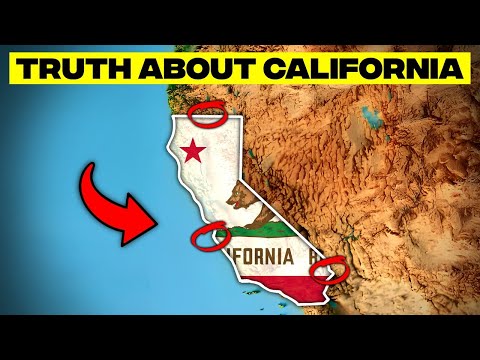
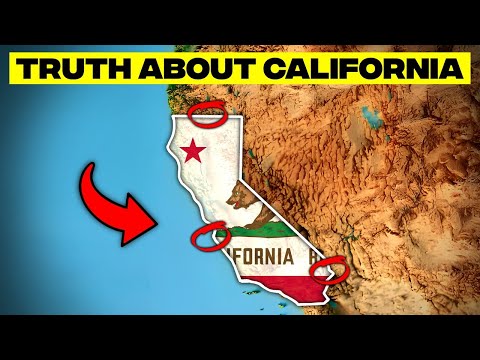
California, often painted as a sun-drenched, easygoing paradise, is in reality a geological maelstrom, a place where the planet's raw power is constantly on display. Its landscape is a tapestry woven from extremes: the highest point in the contiguous United States stands mere miles from its lowest, while supervolcanoes simmer beneath serene mountains. Here, ancient forests drink fog, and lakes vanish and reappear with unnerving regularity, challenging every notion of stability. It is a land of paradoxes, where the very ground beneath your feet is perpetually shifting, eroding, or rising. Prepare to have your understanding of geography radically reshaped.
Land of Extremes: Peaks and Depths
Highest and lowest points, neighbors 88 miles apart.
California hosts the contiguous United States' highest and lowest points, separated by just 88 miles. Mount Whitney soars to 14,505 feet, while Death Valley's Badwater Basin plunges to 282 feet below sea level, one of Earth's lowest points. A hiker can traverse these extremes, from thin mountain air to scorching salt flats, in a single weekend.
World's smallest mountain range rises from farmland.
North of Sacramento, the Sutter Buttes form the world's smallest mountain range. They are just 10 miles wide and approximately 2,000 feet tall, appearing like a rugged island in a sea of farmland. Local Maidu legend claims this as the resting place of the Earth's creator, a strange, isolated anomaly in the valley.
Nine national parks, each showcasing a different extreme.
California boasts more national parks than any other state: nine in total. These include Death Valley, the hottest place on Earth, Redwood National Park with the tallest trees, and Yosemite with North America's tallest waterfall. It is like packing an entire continent's diverse geography into one state, offering everything from glaciers to desert gardens.
Ancient lava formed perfect hexagonal stone columns.
Devil's Post Pile, in the Sierra Nevada, features tall, hexagon-shaped stone columns formed naturally from lava. Around 80,000 to 100,000 years ago, a volcanic eruption sent basalt lava flowing, which cooled and cracked into near-perfect hexagons. Glaciers later scraped the tops flat, creating a tiled surface resembling Ireland's Giant's Causeway.
Most symmetrical natural dome, a subtle desert sculpture.
Cima Dome, a granite feature in the Mojave, is considered the most symmetrical natural dome in the US. Spanning 75 square miles, it rises barely 1,500 feet above the desert floor. Millions of years of wind and water carved this once jagged mountain into its sleek, whaleback curve, creating a quiet yet unforgettable marvel.
Sci-fi spires rise from an ancient desert lakebed.
In the remote Searles Dry Lakebed of the Mojave, over 500 tufa spires, known as Trona Pinnacles, rise from the ancient lakebed, some reaching 140 feet. They formed underwater 10,000 to 100,000 years ago. This alien landscape has served as a filming location for science fiction movies like Star Trek and Planet of the Apes.
Water's Wild Side: Accidental Seas and Vanishing Lakes
North America's oldest lake, a living time capsule.
Mono Lake, in eastern California, is North America's oldest lake, estimated to be over 760,000 years old, possibly a remnant of a lake 1 to 3 million years old. This surreal, salt-rich environment is famous for its bizarre tufa tower formations and is home to salt-loving microbes and brine shrimp thriving in water almost three times saltier than the ocean.
Accidental sea created by an engineering mishap.
The Salton Sea, California's largest lake, was created by an engineering mishap in 1905. Engineers mishandled an irrigation canal from the Colorado River, causing it to flood a desert basin for two years. At one point, it stretched 45 miles across, transforming a dry salt flat into an inland sea that is now shrinking annually.
Massive Lake Tahoe could flood California 14 inches deep.
Lake Tahoe is so massive that if its water were spread across California, the entire state would be under about 14 inches of water. At 1,645 feet deep, it could hide the Empire State Building with room to spare. Its water is incredibly clear, allowing visibility down more than 70 feet in some spots, and it never freezes.
Giant bathtub drain controls a lake's water level.
In Napa County, Lake Berryessa features a massive overflow spillway called the Glory Hole, resembling a giant spinning hole. This 72-foot wide concrete funnel can drain over 360,000 gallons per second when the lake is full, sucking water 200 feet down into Putah Creek below. Only one person and one duck have ever been pulled in.
Toxic dust bowl born from a drained lake.
Owens Lake, once a 110-square-mile wonder, was drained dry by Los Angeles in 1926 to supply water to the growing city. This created a dusty wasteland where windstorms whipped up alkali dust mixed with arsenic, causing the EPA's worst PM10 pollution problem. LA has spent over a billion dollars trying to fix this environmental nightmare.
Ghost lake reborn after a century of absence.
Tulare Lake, once the largest freshwater lake west of the Mississippi, was drained for farmland by 1900. However, in 2023, an unmatched series of storms brought it back to life, flooding over 100,000 acres of farmland. Locals watched in shock as the "Zombie Lake" spread, a major reminder that even extinct lakes in California can reappear.
Pink lakes formed by tiny salt-loving organisms.
If you fly into San Francisco, you might notice bright pink and red ponds along the bay. These are salt ponds, and their wild colors come from tiny algae and microbes that thrive in super salty water. Organisms like halobacteria and dunaliella salina grow rapidly as salt levels rise, turning the water pink or deep red across 16,000 acres.
California's geography, far from being a collection of static features, is a dynamic narrative of constant change, epic forces, and bizarre natural phenomena.
Earth's Restless Heart: Faults and Fire Beneath
Supervolcano lurks beneath quiet mountains.
Under the mountains near Mammoth Lakes sits the Long Valley Caldera, one of Earth's biggest supervolcanoes. Around 760,000 years ago, it exploded in a massive eruption, sending out 600 cubic km of ash and leaving a 20-mile wide crater. Signs like shifting ground, CO2 gas killing trees, and hot springs indicate it is still active.
Fault lines constantly reshape the land.
California has over 700 named earthquake faults, experiencing around 10,000 quakes annually, though most are unfelt. The San Andreas Fault, an 800-meter wide zone, has been moving for over 20 million years. In 1992, the coast near Humboldt was lifted 15 feet instantly, and in 2010, an area near the Salton Sea sank by several feet.
Moving mud lake monster defies engineering efforts.
In Imperial County, the Nyl Geyser, a bubbling gray mud pot, has been slowly creeping across the desert since 2007. It has slid over 280 feet, forcing engineers to reroute highways and train tracks and even dig a 75-foot deep steel wall, which the mud simply went around. This slow-moving pool spits out about 40,000 gallons a day.
Central Valley slowly sinking from groundwater pumping.
California's Central Valley is literally sinking, a consequence of years of pumping groundwater for farming and cities. A 2024 Stanford study found parts of the San Joaquin Valley have dropped faster than ever since 2006. Some spots have sunk nearly 30 feet since the 1920s, causing cracked roads, warped bridges, and buckled canals visible from space.
San Francisco and Los Angeles are on a collision course.
Los Angeles is creeping about two inches north every year along the San Andreas Fault, slowly drifting toward San Francisco. This movement of tectonic plates means that over millions of years, the two cities could eventually merge. This slow shift also builds immense pressure, which is released in the form of earthquakes, making the collision course dangerous.
Creek clearly shows the San Andreas Fault's shifts.
At Wallace Creek in the Carrizo Plain, the San Andreas Fault's impact is vividly clear. The creek zigzags, pushed about 430 feet out of place by thousands of years of earthquakes. One massive quake in 1857 moved part of it 30 feet in a single day. Standing with one foot on each side means standing on two different tectonic plates.
World's largest geothermal field powers California.
The Geysers, located 72 miles north of San Francisco, is the world's largest geothermal field. It houses 18 geothermal power plants that produce about 1.5 gigawatts, enough for 1.4 million people. This 45-square-mile cauldron has been churning out steam since 1960, generating half of California's geothermal energy from ancient magma cooking groundwater.
Weather's Whims: Fire, Rain, and Ice
Tropical storm hit Southern California in 1939.
The only tropical storm to hit Southern California in modern times made landfall in 1939. Named the Lash of St. Francis (El Cordonazo), it slammed the coast with 65 mph winds and dropped 5 inches of rain in one day. Long Beach saw houses swept into the ocean, and the LA River flooded, leading to the creation of a local weather office.
Fire tornado with 143 mph winds during wildfire.
During the 2018 Carr Fire near Redding, a fire tornado formed, combining flames and wind into a terrifying phenomenon. This spinning tower of fire hit wind speeds of up to 143 mph, ripping trees from the ground and bending steel power poles. The National Weather Service gave it an EF3 rating, similar to a strong tornado, showcasing the intensity of California wildfires.
World record for hottest rain recorded.
California holds the record for the hottest rain ever recorded. On July 24, 2018, in Imperial Valley, it rained while the air temperature was a blistering 119°F (48°C). Most droplets evaporated before reaching the ground, but a trace hit the gauge, setting a world record. The previous record was also in California, 118°F rain in Needles in 2012.
California's record coldest night, rivaling Alaska.
California's record low temperature is -45°F (-43°C), recorded in January 1937 in Boca, a tiny Sierra Nevada town. This is colder than the lowest temperatures recorded in Montana or Idaho. Boca's deep basins trap cold air like a giant freezer. In 1989, Boca hit -43°F again, setting a February record, proving the Golden State's extreme temperature range.
1862 flood created a 300-mile inland sea.
In the winter of 1861-62, a non-stop 45-day storm triggered California's worst flood, turning the Central Valley into a massive 300-mile long lake with some areas under 30 feet of water. Sacramento was so badly flooded that the state government temporarily moved to San Francisco. Geologists call these "ark storms," which tend to hit every 100 to 200 years.
Desert's Deceptions: Moving Stones and Ghost Cities
Mystery of sailing stones solved by ice and wind.
For years, massive stones mysteriously slid across Death Valley's Racetrack Playa, leaving long winding trails. In 2014, scientists finally caught it on camera: after rare winter rains, a thin layer of ice forms. When the sun comes out, the ice breaks into sheets, and light winds push the ice, nudging the rocks across the wet, slippery mud. It can take years for a single track to form.
Mojave Desert once home to camels and flamingos.
Fossils found in the Mojave Desert near Barstow tell of a time when this arid region was lush. Scientists have uncovered remains of camels, mammoths, saber-toothed cats, and even flamingos. These fossils, along with petrified palm trees and ancient turtles, indicate that this desert was once a much greener, wetter place, covered in wetlands and tropical-like environments.
Singing sand dunes hum a low, steady tone.
In California's Mojave Desert, the Kelso Dunes sometimes produce a deep echoing sound, almost like the desert is humming. When the sand is dry and conditions are right, shifting grains rub together to create a low, steady tone that can last for minutes. Only about 30 places worldwide exhibit this strange effect, and hikers sliding down the slopes can trigger the sound themselves.
Ghost grid of a city that never really happened.
California City, in the Mojave Desert, is a place with a big name but few people. Developers in the 1950s built miles of roads, intending to create a massive city, but the population never arrived. Today, it is California's third largest city by land area, but only about 15,000 people live in one small section. The rest is a quiet grid of empty streets, a "ghost grid."
Town named Zzyzx, alphabetically last place name.
California is home to a town named Zzyzx, pronounced "Zizix." Located on the edge of the Mojave, Zzyzx Road leads to a spot once home to a 1940s health spa. The shady doctor who built it picked the last letters of the alphabet to claim the last word in town names. Today, it is a desert study center, but the name remains a pure gimmick and the alphabetically last place name in the world.
Ancient Giants and Tiny Survivors: California's Unique Life
World's tallest, biggest, and oldest trees in one state.
California is the only place on Earth home to the world's tallest, biggest, and oldest living trees. The Coast Redwood (Sequoia sempervirens) reaches heights of up to 379 feet. The Giant Sequoia (Sequoiadendron giganteum) can weigh around 2,000 tons. And the oldest Bristlecone Pine, Methuselah, is nearly 4,800 years old, predating the pyramids.
Redwoods drink fog to survive dry summers.
California's coastal redwoods, the tallest trees on Earth, employ a unique survival strategy during dry summers: they drink fog. These giants can take in around 160 gallons of water a day. When rain stops, fog droplets collect on their needles and drip to the roots, a process called fog drip, which can account for up to 40 percent of their water intake.
Alkali flies scuba dive in toxic Mono Lake.
Mono Lake's salty, acidic water is nearly as harsh as ammonia, yet it is home to alkali flies with an incredible trick. These flies can walk underwater, completely wrapped in a bubble of air, like they are wearing little scuba suits. Their bodies are covered in tiny hairs and a waxy coating that repels water, trapping air. They dive to feed and lay eggs, then float back up, still breathing. Even Mark Twain was amazed, noting they go under and come out totally dry.
Ghostly white redwoods steal nutrients from neighbors.
Tucked away in California's redwood forests are strange, pale trees known as albino redwoods or ghost trees. Their white needles signify a rare mutation leaving them without chlorophyll, so they cannot make their own food. They survive by connecting their roots to nearby redwoods and stealing nutrients. Scientists found these ghost trees also soak up toxic heavy metals, acting as a natural filter at much higher levels than normal redwoods.
General Sherman, Earth's largest tree by volume.
The General Sherman, located in Sequoia National Park, is the largest tree on Earth by volume. Standing 275 feet tall with a trunk over 36 feet wide, it holds more than 52,500 cubic feet of wood. Weighing about 1,385 tons, it is still growing, adding enough new wood each year to make a 60-foot tree. It has stood since the Roman Empire.
Redwoods' strength comes from shallow, interconnected roots.
Despite being the tallest trees on Earth, coast redwoods only have roots that go 6 to 12 feet down. To stay upright, these 350-foot giants stretch their roots outward up to 100 feet and weave them with neighboring redwoods. This creates a massive underground network, a sturdy, interconnected grid where every giant leans on its neighbors for support.
Hyperion, world's tallest tree, kept secret for protection.
Hidden deep in Redwood National Park is Hyperion, the world's tallest tree, measuring about 380 feet tall. Discovered in 2006, its exact location is kept secret to protect it from damage and disturbance, especially to its sensitive roots. It likely started growing during the time of the Crusades. As of 2022, visiting it is completely off limits, with fines or jail time for violators.
Bison roam California's Santa Catalina Island beaches.
Santa Catalina Island is home to a surprising herd of 100 to 150 American bison, an unexpected sight against ocean backdrops. They are not native: 14 were brought in 1924 for a Hollywood Western and left behind. The herd thrived, growing to around 600, but today the Catalina Island Conservancy keeps it at a manageable size to protect the island's ecosystem.
Pocket-sized island foxes, North America's smallest.
California has its own tiny island fox, North America's smallest fox, found nowhere else on Earth. These little guys, about the size of a chihuahua and weighing just 4 to 5 pounds, live only on six of the Channel Islands. They evolved from gray foxes, adapting to island life. After nearly going extinct, they made one of the quickest conservation comebacks ever.
Methuselah, one of Earth's oldest living trees.
Tucked high in California's White Mountains is Methuselah, a Bristlecone Pine believed to be more than 4,850 years old, possibly the oldest living tree on Earth. This ancient tree was already growing strong before the pyramids in Egypt were built. Its exact spot is kept secret for protection, but the surrounding grove contains other gnarled, thousands-of-years-old trees.
California's landscape isn't just terrain, it's a forge of quirky stories from a secession over whiskey to rain falling at 119 degrees Fahrenheit.
Human Footprints and Quirky Tales
Los Angeles's sneaky, 16-mile shoestring border.
Los Angeles has a bizarre, snake-like border, a narrow 16-mile stretch, sometimes less than a mile wide, extending south. Known as the "shoestring," this unusual strip was annexed in 1909 so LA could secure its own seaport in San Pedro. This genuine land corridor allowed Los Angeles to reach the busiest port in the country, a bizarre city boundary solution.
Grunion Run: fish fling themselves onto beaches.
In Southern California, the Grunion Run is a unique natural event where thousands of shiny silver fish ride waves onto the beach during spring and summer nights, right after a full or new moon. They flop around on the sand to lay their eggs, making them one of the only fish species that willingly strand themselves to spawn. Locals call it a "midnight fish rave" as the shore turns into a shimmering, moving blanket of fish.
Rainbow-colored boiling springs of Bumpass Hell.
Deep inside Lassen Volcanic National Park is Bumpass Hell, a 16-acre patch of steaming vents, bubbling mud pots, and neon blue pools that looks like another planet. The smell of sulfur hits before you see it. The main feature, Big Boiler, blasts steam at 322°F. It is named after Kendall Bumpus, an early explorer who fell through the crust and badly burned his leg.
La Brea Tar Pits, a fossil gold mine in Los Angeles.
Right in the middle of Los Angeles, the La Brea Tar Pits have preserved over 3.5 million fossils from the Ice Age, including mammoths, direwolves, and saber-toothed cats. More than 600 different species have been uncovered here, making it one of the richest fossil sites in the world. Paleontologists are still pulling out new finds, even tiny insects, just steps from busy sidewalks.
Republic of Rough and Ready, a town's brief independence.
The tiny Northern California town of Rough and Ready, with a population of around 900, once declared independence in 1850. Frustrated with taxes, miners proclaimed themselves the "Great Republic of Rough and Ready." The rebellion was short-lived: legend has it they rejoined the Union after just 3 months when neighboring towns refused to sell them whiskey for being foreigners.
Lunar rainbows glow in Yosemite National Park.
In Yosemite National Park, something incredible happens on the right spring or summer night. If the moon is full, the sky is clear, and the waterfalls are flowing strong, you might catch a moonbow. It is like a rainbow, but made from moonlight. These soft, glowing arcs appear in total darkness, usually around midnight, as the mist from Yosemite Falls, at 2,425 feet, bends the moon's light into a pale, ghostly rainbow.
The Lost Coast, California's roadless, rugged frontier.
In Northern California, the Lost Coast is a stretch of land so rugged and remote that Highway 1 gave up trying to pass through it. For about 60 miles, steep cliffs and unstable ground forced the road inland, leaving this coastline untouched. It is one of the only places in the lower 48 states with no major road access, just rough trails, tiny towns, and wild ocean views.
Ancient tufa towers exposed by dropping lake levels.
Around Mono Lake's edge, strange, jagged tufa towers rise from the ground, looking like rock sculptures or something out of a science fiction movie. These spooky spires formed underwater when calcium-rich spring water bubbled up and mixed with the lake's carbonates. For years, they were hidden until Los Angeles diverted Mono Lake streams, dropping the water level by over 40 feet, exposing some towers nearly 30 feet tall.
Death Valley Junction, a town of 1,000 oddities.
California's wild spirit is epitomized by Death Valley Junction and the Amarosa Opera House. In the 1960s, ballerina Marta Beckett moved to the desert, painted murals of an audience inside the theater, and performed solo ballets to an empty, painted crowd. This remote outpost, far from urban centers, is a testament to the quirky, unexpected human stories etched into California's unique landscape.
California's coldest town can rival Alaska's winter.
While Death Valley holds the world's heat record, up in the Sierra, California can rival Alaska's cold. The town of Boca, near Truckee, recorded -45°F (-43°C) in January 1937, the state's record low. Boca's deep basins trap cold air like a giant freezer, making it consistently one of the coldest spots. In 1989, it hit -43°F again, setting a February record.
California's geography, far from being a collection of static features, is a dynamic narrative of constant change, epic forces, and bizarre natural phenomena. It reminds us that the world is not merely a map of fixed points, but a living, breathing entity full of plot twists and surprises that defy conventional wisdom. Across The Globe believes that true understanding comes from embracing these geographical eccentricities, recognizing that the planet is always stranger, and more fascinating, than school ever taught us.