Michigan, the Great Lakes State, is often reduced to stereotypes of automotive innovation or fiercely contested college sports. Yet, beneath its placid surface and familiar geography lies a landscape of astonishing extremes and ancient secrets. Imagine a place where the ground itself shudders with frost quakes, where entire towns vanish under advancing sand, and where oceans of freshwater conceal prehistoric hunting grounds. This isn't just a state, it's a geological canvas painted with the raw, untamed forces of nature, a place where the ordinary constantly gives way to the utterly bizarre. Prepare to have your understanding of the Midwest utterly redefined.
The Earth's Deep Memory
Detroit hides an entire salt metropolis underground.
Beneath Detroit's streets, a vast network of salt mines stretches over 100 miles. Formed 400 million years ago from an ancient seabed, trucks now navigate corridors 1,400 feet below the city, extracting over a million tons of salt annually to de-ice the roads above.
A continental rift almost tore North America apart.
Around a billion years ago, the Mid-Continent Rift nearly split North America, unleashing one of Earth's largest lava floods. The Greenstone flow alone released over 6,000 cubic kilometers of lava, enough to bury the entire state under 30 feet of rock. Today, its cooled veins hold the copper and iron that built Michigan's industrial might.
Michigan sits atop a giant, geological bullseye.
The Lower Peninsula rests on the Michigan Basin, a three-mile deep bowl of rocks stacked in concentric rings. Each layer, formed over hundreds of millions of years, preserves a different era, containing fossil reefs, salt beds, and oil from vanished ancient oceans.
A supervolcano once powered Michigan's formation.
Michigan's Keweenaw Peninsula conceals the cooled remains of a 1.1 billion year old supervolcano. This colossal eruption, powerful enough to reshape a continent, gushed lava for centuries, creating the 10,000 foot thick basalt cliffs visible in the region today.
A 5-mile wide meteor crater hides under farmlands.
Beneath Cass County's agricultural fields lies the Calvin Crater, a five-mile wide impact scar. Formed 450 million years ago when a space rock struck an ancient ocean floor, it remains invisible on the surface, detectable only by seismic scans.
Saginaw Bay's shape hints at a cosmic mystery.
From space, Saginaw Bay appears as if a cosmic ice cream scoop gouged out its perfect arc. While scientists attribute its formation to glaciers, local legends persist that a prehistoric meteor impact created this massive, county-sized dent in Michigan's eastern coastline.
Michigan's oil is essentially fossilized tropical seas.
Roughly 400 million years ago, Michigan was covered by a tropical sea teeming with Silurian reefs. Over eons, the pressure and heat transformed this ancient marine life into crude oil, allowing Michigan to quietly produce over a billion barrels of oil.
Mackinac Island is built upon ancient tropical reefs.
Walking on Mackinac Island means traversing 400-million-year-old fossilized coral reefs. Michigan once lay near the equator, submerged in a tropical sea. Over time, these vibrant reefs turned into the limestone that forms iconic landmarks like Arch Rock, moved north by continental drift.
Michigan's state stone is ancient, tropical coral.
The Petoskey stone, Michigan's official state stone, is not a gemstone but fossilized coral from a tropical sea that existed 350 million years ago. When wet or polished, these fossils reveal perfect honeycomb patterns, preserving a piece of the Devonian ocean floor.
Echoes of Prehistoric Life
Michigan was once home to giant ice age elephants.
Over 250 mastodons have been unearthed in Michigan, making it one of the richest sites for these Ice Age giants. In 1992, near Ann Arbor, scientists discovered a trackway of 30 mastodon footprints, the longest fossil trail of its kind in the world.
A mastodon's clumsy moment preserved in stone.
The Ann Arbor mastodon trackway reveals perfectly preserved footprints, including one where a massive beast slipped in ancient mud 11,000 years ago. This rare glimpse into Ice Age life allows paleontologists to study the weight, gait, and behavior of these extinct giants.
America's first industrial miners worked Michigan.
Around 4,000 BC, indigenous miners in Michigan carved over 5,000 pit mines on Isle Royale and the Keweenaw Peninsula. Using stone hammers, they extracted tons of pure copper, forging tools and trade goods that traveled as far as New England, establishing an ancient industrial operation.
A 3,700lb boulder of pure copper was found.
Michigan's Upper Peninsula once yielded the Antonagon boulder, a single 3,708 pound mass of nearly 100 percent pure copper. For centuries, indigenous tribes considered it sacred before it was eventually moved to the Smithsonian in 1843, where it remains on display.
A prophet predicted a devastating Michigan earthquake.
In 1811, Shawnee leader Tecumseh warned of a sign that would shake the earth. Shortly after, the massive New Madrid earthquake, centered hundreds of miles away, rattled Michigan's foundations and caused church bells in Detroit to ring, leading many to believe Tecumseh had called it down.
Trucks drive through corridors 1,400 ft below the city, mining over a million tons of salt every year just to melt ice off the roads above.
Water's Unconventional Wonders
An island in a lake on an island in a lake.
Isle Royale, in Lake Superior, contains Cisco Lake. Within Cisco Lake lies Moose Boulder, a smaller island. This creates a geographically absurd nesting doll: an island in a lake on an island in a lake on an island, a rare example of recursive geography.
Lake Huron hosts primitive, alien-like organisms.
Deep beneath Lake Huron, ancient sinkholes glow with ghostly light. These "blue holes" are filled with toxic brine where no fish can survive, yet they teem with brilliant purple and white bacteria mats. Scientists consider these primitive organisms "time capsules" of early Earth, akin to alien life.
Michigan has a lake that vanishes every year.
Mystery Valley in northern Michigan is a 1.5-mile long, 150-foot deep canyon that fills with water only in spring. By summer, the lake drains into underground cracks through a collapsed limestone sinkhole, leaving a dry forest floor until the cycle repeats. You can hike across a former lake bed without knowing it.
Kitch-iti-kipi: Michigan's crystal clear big spring.
In Michigan's Northwoods, Kitch-iti-kipi, meaning "big cold water," is a spring so clear you can see 45 feet to the bottom. Over 10,000 gallons of water flow out every minute, maintaining a constant 45°F temperature year round, preventing it from freezing even in deep winter.
Michigan's North Woods holds a Caribbean blue lagoon.
Near Alpena, a chain of sinkhole lakes, including Lake 7, shimmer with astonishingly turquoise water. Minerals filtered through deep limestone craters give the water an electric, Caribbean blue hue. In winter, they freeze into glowing turquoise ice discs, creating tropical-like lagoons in the heart of the Great Lakes.
The Great Lakes experience powerful, inland tides.
Despite being freshwater, the Great Lakes exhibit "seiches," massive sloshing waves caused by winds, air pressure, and even lunar gravity. These can cause water levels to rise and fall several feet across an entire lake. In 1954, a sudden 10-foot seiche slammed into Chicago's shoreline, claiming eight lives.
Lake Michigan produces erupting ice volcanoes.
During winter, when Lake Michigan's waves crash against a frozen shoreline, they can force bursts of water through cracks in the ice. This creates "ice volcanoes" that spout slush and spray, sometimes growing over 10 feet tall before disappearing, a unique geological phenomenon sculpted by extreme cold.
Michigan is a true water winter wonderland.
Michigan's old license plate slogan captures its essence, boasting over 11,000 inland lakes and 36,000 miles of streams. Winter transforms these into recreational havens, from Grand Island's ice caves to Mackinac Island's blue ice formations, with lake effect snow burying areas under multiple stories of powder.
Unseen Forces and Strange Landscapes
Michigan has its own Sahara, made of freshwater.
Along Lake Michigan's coast, colossal freshwater dunes rise up to 450 feet high, forming the largest such system on Earth. Sculpted by Ice Age winds, these giants, like the Sleeping Bear Dunes, look like a glowing ribbon of gold from space, resembling a desert landscape without the salt.
Silver Lake's dunes are constantly on the move.
The Silver Lake Sand Dunes, spanning over 2,000 acres, are a dynamic landscape where sand continuously shifts and reshapes under persistent westerly winds. These mobile dunes advance inland year after year, burying forests in their path, with dead treetops occasionally protruding like skeletal markers of consumed land.
Pictured Rocks: cliffs that bleed vibrant color.
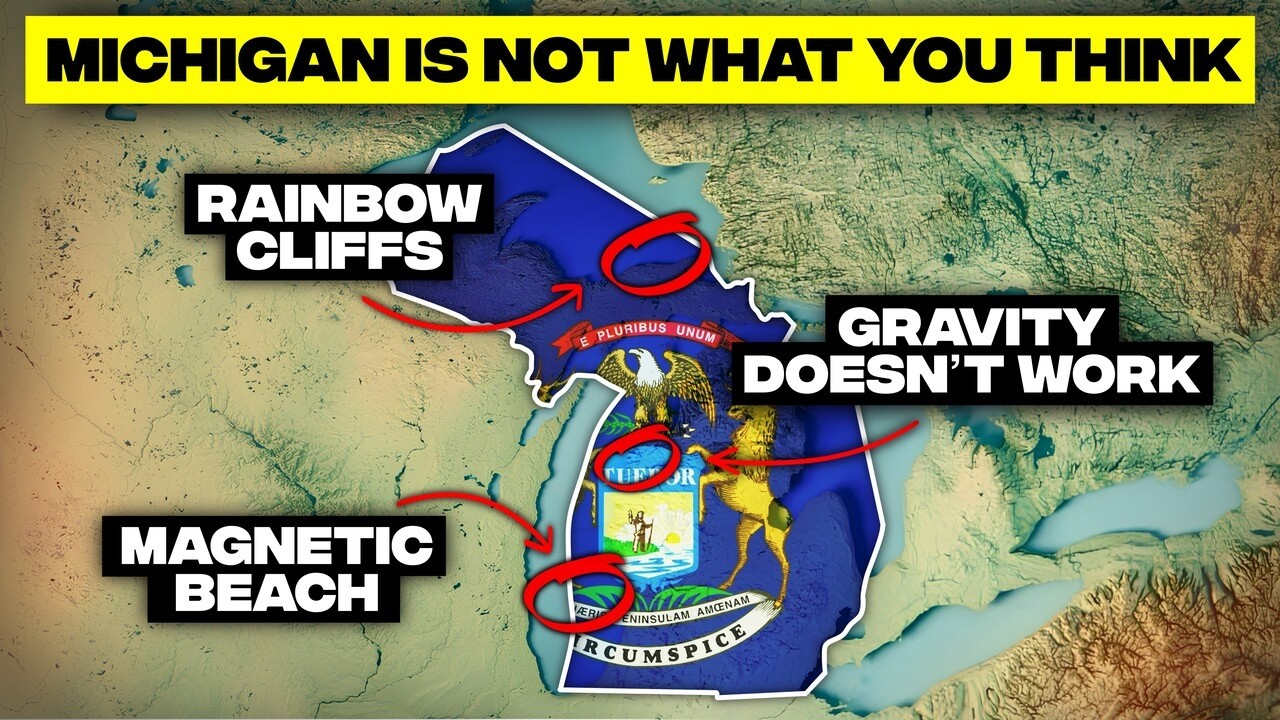
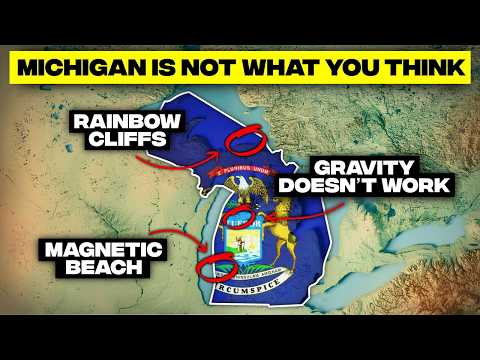
Along Lake Superior, the Pictured Rocks rise 50 to 200 feet high, stretching for 15 miles. These sandstone cliffs are streaked with red, blue, green, and gold, not from paint, but from metallic oxides like iron and copper bleeding from within the rock, creating a natural, ever-changing rainbow.
Lake Huron sculpted a giant, turnip-shaped rock.
At Michigan's thumb tip stands Turnip Rock, an isolated limestone pinnacle carved by millennia of wave action. Selective erosion left a resistant core standing, resembling a giant vegetable or mushroom emerging from Lake Huron, topped with trees, making it accessible only by kayak.
A Michigan beach literally sings when touched.
At Bay de Noc on Lake Superior, the sand emits squeaks, hums, and even "talks" when disturbed. This phenomenon occurs because each grain is perfectly rounded quartz, and their friction generates sound, turning the beach into a natural instrument powered by footsteps.
Michigan beaches contain streaks of magnetic sand.
Many Great Lakes shores are lined with streaks of black magnetic sand that leap towards a magnet. This is due to magnetite, an iron-rich mineral, mixed with flecks of garnet and even gold. Waves have sorted these dense metals over millennia, turning beaches into glittering, magnetic ore fields.
A mysterious hill defies gravity, rolling cars uphill.
Near Bald Mountain Recreation Area, a stretch of road known as "Gravity Hill" causes cars in neutral to mysteriously creep backward uphill. This optical illusion, created by the warped horizon and tree line, tricks the brain into perceiving an uphill slope as downhill, making water appear to flow the wrong way.
Michigan rocks glow like lava under UV light.
On Lake Superior's beaches, ordinary gray stones called "Yuper lights" explode into blinding neon orange under ultraviolet light. These fluorescent sodalite rocks, discovered in 2017, transform Michigan's shores into cosmic treasure hunts after dark, glowing like molten magma.
The ground itself can explode, causing frost quakes.
On brutal Michigan winter nights, when temperatures plunge below zero, the frozen ground can contract faster than it expands, causing it to crack open with a sound like a gunshot. These "cryoseisms" or frost quakes rattle windows and shake walls, as the earth itself snaps under pressure.
Sunken Histories and Maritime Mysteries
An ancient, 9,000 year old highway lies underwater.
Beneath Lake Huron rests an Ice Age highway, a rocky ridge that once connected Michigan to Ontario. 9,000 years ago, caribou migrated across it, followed by ancient hunters. Archaeologists discovered stone drive lanes and ambush pits, making it the oldest preserved hunting site in the Great Lakes, now 100 feet underwater.
A complex Stone Age hunting ground under Lake Huron.
120 feet below Lake Huron lies the most complex prehistoric hunting structure ever found underwater. Precisely placed stones form V-shaped drive lanes and caribou pens, built 9,000 years ago. This underwater "Stonehenge" was engineered by indigenous hunters to funnel herds, a testament to their advanced understanding of animal migration.
Lake Michigan hides a mysterious sunken Stonehenge.
In 2007, scientists found a line of giant stones arranged in an arc 40 feet underwater in Lake Michigan. One stone appears to bear a carving of a mastodon, an animal extinct over 10,000 years ago. Its origin remains a haunting mystery, suggesting human presence on land now buried beneath the lake.
The Great Lakes conceal over 6,000 shipwrecks.
The Great Lakes hide a vast fleet of over 6,000 shipwrecks, with more than 1,500 resting in Michigan waters, earning the nickname "Shipwreck Alley." The cold, freshwater preserves these vessels in remarkable condition, creating an underwater museum frozen in time, from 1600s traders to 1900s freighters.
Lake Superior's chilling secret: frozen corpses.
Lake Superior's famous refusal to "give up her dead" is a scientific reality. The lake's water remains around 40°F year-round, which halts decomposition and prevents gases from forming. Bodies that sink stay perfectly preserved for decades, or even a century, never floating back to the surface.
Kayak over an underwater graveyard in Michigan.
Just off Alpena's coast, the Thunder Bay Marine Sanctuary holds over 100 shipwrecks, many in water so shallow you can kayak directly above them. The crystal clear freshwater preserves these vessels in near-perfect condition, offering a unique, non-diving glimpse into 150 years of maritime history.
For decades, it's been Michigan's strangest roadside attraction, a place where physics and perception collide.
Human Impact and Nature's Fury
Michigan's Upper Peninsula was an accidental goldmine.
In the 1830s, Michigan received the Upper Peninsula as a "consolation prize" in a border dispute over Toledo. Deemed a worthless frozen wilderness, it later revealed billions in copper, iron, and timber, transforming what seemed like the worst deal in US history into an industrial jackpot.
An entire Michigan town was swallowed by sand.
Singapore, a booming lumber town on Lake Michigan, vanished when logging stripped away protective forests. Windblown sand advanced 10 feet per year, burying houses and streets. By the 1870s, the entire town was entombed beneath the dunes, a forgotten Pompeii consumed by sand rather than lava.
Michigan's Upper Peninsula is a graveyard of ghost towns.
Dozens of abandoned communities litter the UP, remnants of the 19th and early 20th century copper mining and logging booms. Fayette, a bustling iron smelting town, and Central Mine, with 1,200 residents, were left behind when resources dwindled, their crumbling buildings slowly dissolving into the forest.
Devastating firestorms ravaged Michigan in 1871.
On October 8, 1871, the same day as the Great Chicago Fire, infernos ripped through Michigan, torching 2 million acres in a single weekend. Fueled by drought and logging debris, these firestorms created tornadoes of flame, causing trees to explode and entire towns like Holland and Manistee to vanish overnight.
Volcanic ash from global eruptions covered Michigan.
Though Michigan lacks volcanoes, it has been dusted by their wrath. Ash from Mount St. Helens (1980) traveled 1,900 miles to fall on Michigan cars. The 1883 Krakatoa blast in Indonesia painted Michigan sunsets blood red for months, demonstrating how global atmospheric events impact the state.
The Mitten's Unique Edges and Extremes
The Keweenaw Peninsula once received 32 feet of snow.
During the winter of 1978-1979, Michigan's Keweenaw Peninsula was buried under a staggering 32 feet (390 inches) of snow. This extreme accumulation, capable of burying a three-story building, is thanks to Lake Superior's relentless lake effect, which regularly delivers over 240 inches each winter.
Michigan experiences a 163-degree temperature swing.
Michigan can swing from Arctic tundra to Death Valley heat within the same year. In 1934, Vanderbilt hit -51°F, while just two summers later, Mio reached 112°F. This 163-degree range is wider than almost anywhere else in North America, necessitating both parkas and beach shorts.
Michigan's coastline is longer than California's.
Surrounded by four Great Lakes, Michigan boasts 3,288 miles of freshwater shoreline, surpassing the coastlines of California, Florida, or Hawaii. When including every island and bay, it becomes the longest freshwater coastline on Earth, offering endless beaches without tides, sharks, or salt.
Isle Royale is a living, isolated ecological fossil.
Remote Isle Royale National Park, closed half the year, hosts one of the world's longest running predator-prey experiments: isolated populations of wolves and moose battling for survival since 1948. With no roads or permanent residents, it serves as a living time capsule of North American wilderness before human interference.
Michigan possesses a beautiful, secret third peninsula.
Beyond its well-known two peninsulas, Michigan features the Garden Peninsula, jutting into Lake Michigan. This quiet region boasts cliffs, turquoise waters, and the ghost town of Fayette, an abandoned iron smelting village. A unique microclimate here even allows southern trees like the Kentucky coffee tree to thrive.
A desert of grass exists within Michigan's waterscape.
The Shiawassee National Wildlife Refuge and Southern Prairie Fens form an "inland Everglades" of huge, wet grasslands that seasonally flood. Hiding rare plants, including the endangered eastern prairie fringed orchid, this forgotten ecosystem proves Michigan is also a state of expansive grasses and ecological secrets.
A giant mushroom hides spanning 91 acres underground.
Near Crystal Falls, a single fungus, nicknamed the "humongous fungus," stretches 91 acres underground and weighs an estimated 440 tons, equivalent to three blue whales. This ancient organism, approximately 2,500 years old, quietly grows, its roots weaving through the soil like a living network.
Michigan’s hydrological network creates year-round drama.
With over 11,000 inland lakes and 36,000 miles of streams, Michigan’s hydrological system is outrageously complex. This network, combined with extreme winter conditions, creates dramatic natural phenomena like ice caves and Narnia-like frozen paths, making it a season-chasing paradise defined by water and winter.
From ancient coral beds turned to stone beneath bustling tourist towns to magnetic sands shimmering on forgotten beaches, Michigan proves that geography is the ultimate storyteller. The world, as it turns out, is far stranger and more dynamic than any textbook might suggest. These 50 facts are merely glimpses into the geological plot twists and ecological dramas that constantly unfold across this remarkable state, inviting us to look closer and uncover the hidden wonders beneath our very feet.