Oregon, the Beaver State, often conjures images of misty forests and rugged coastlines, but beneath its verdant surface lies a landscape of staggering, sometimes unsettling, geographical anomalies. Here, lakes vanish without a trace each summer, rivers spring forth fully formed from underground, and entire cities have been swallowed by floods or built atop slumbering volcanoes. From ancient geological events that shaped colossal canyons and painted hills, to the more recent, peculiar interactions between humans and the wild, Oregon consistently defies expectation. It is a place where the planet's raw power is still visibly at play, offering a constant reminder that the world is far stranger and more dynamic than any textbook might suggest.
Oregon's Fiery Foundations
Hells Canyon: Deeper than its famous Grand Canyon cousin.
Along Oregon's eastern border, Hells Canyon plunges an astounding 7,993 feet, nearly 2,000 feet deeper than the Grand Canyon. Carved by the Snake River, its walls display ancient lava flows and twisted rock, forming a vertical history book millions of years old. Much of this rugged canyon is only accessible by boat, horseback, or sheer determination.
Crack in the Ground: A trail inside the earth.
Near Christmas Valley, Oregon literally splits open. Crack in the Ground is a 2-mile volcanic fissure, up to 70 feet deep, formed approximately 14,000 years ago when magma tore open the earth. Hikers can walk right down the middle, where the air remains cold and still even on scorching summer days. It feels like a natural hallway through the planet's crust.
Steens Mountain: A giant fault block mountain.
Steens Mountain appears as if the planet itself was kicked sideways. It is one of North America's largest fault block mountains, a single chunk of crust uplifted and tilted by tectonic stress millions of years ago. One side offers a gentle climb, while the other drops a dramatic 5,000-foot cliff into the Alvord Desert below. The sudden drop makes it feel like the world abruptly ends.
Newberry Volcano: A giant with twin caldera lakes.
Just south of Bend, Newberry Volcano is a 500-square-mile behemoth featuring two alpine lakes, Paulina Lake and East Lake, within its 3 by 4-mile summit caldera. Its centerpiece, the Big Obsidian Flow, erupted only 1,400 years ago, spilling a black river of razor-sharp volcanic glass. Indigenous peoples historically mined this glass for tools and arrowheads.
Fort Rock: A tuff ring turned archaeological site.
Fort Rock is the remnant of a maar volcano, formed when magma met water. Its true fame arrived in 1938 when archaeologists discovered 9,000 to 10,000-year-old sagebrush sandals in a cave there. These are some of the oldest footwear ever found in North America, buried by volcanic ash from the eruption that formed Crater Lake.
Portland sits atop a dormant volcanic field.
Portland's urban sprawl rests directly on the Boring Lava Field, a cluster of small extinct volcanoes and cinder cones. These began erupting about 2.7 million years ago, with the last eruption occurring roughly 57,000 years ago. Mount Tabor, located within city limits, is one such extinct vent, making Portland one of the only major US cities built on and around a volcano.
Pillars of Rome: Oregon's striking desert cliffs.
In the remote Owyhee Canyonlands, tan and white volcanic cliffs rise up to 100 feet across a 5 by 2-mile area. Early settlers, perhaps delirious from desert travel, named them the Pillars of Rome due to their resemblance to ancient ruins. These formations were sculpted by wind and water between 2.5 and 5.3 million years ago, creating a surreal environment.
Smith Rock's Monkey Face: A distinctive climbing spire.
Smith Rock State Park is a rock climbing mecca, home to the 350-foot volcanic tuff tower known as Monkey Face. From the right angle, this eroded spire uncannily resembles a primate's profile. Climbing Monkey Face is a rite of passage for serious climbers, with the classic route involving jamming through a chimney inside the "mouth" before reaching the exposed summit. It was first climbed in 1960.
Mount Tabor: Portland's park on an extinct volcano.
Mount Tabor Park in southeast Portland is an extinct cinder cone, part of the Boring Lava Field, which last erupted roughly 57,000 years ago. Rising 643 feet above sea level, it offered panoramic city views. In the early 1900s, Portland built open reservoirs on its slopes to store drinking water, making it one of the few places in the continental US where you could picnic atop a volcano within city limits.
If Oregon had a gateway to the underworld, this would be the entrance.
Ancient Earth's Palette
Painted Hills: Earth's 30 million year mood ring.
The Painted Hills at John Day Fossil Beds appear as if someone spilled a rainbow on the desert. Each stripe of red, gold, and black marks a different climate era, capturing 30 million years of shifting weather. Volcanic ash changed color based on heat and humidity, creating a landscape whose hues subtly alter with the sun's movement, as if the planet itself is breathing in Technicolor.
Blue Basin's seafoam hue from celadonite.
At John Day Fossil Beds Blue Basin, the hills glow seafoam green due to a mineral called celadonite. Millions of years ago, volcanic ash layers were deposited. The chemistry of this ash was altered by hot water seeping through it, leading to the formation of this unique blue-green clay mineral. Erosion has gradually exposed these layers, creating an exotic environment that seems extraterrestrial, especially after rain when the wet clay practically glows.
Painted Cove: Burgundy and lavender claystones.
At Painted Cove in John Day Fossil Beds, the ground resembles a spilled watercolor set, with burgundy and lavender hills rolling quietly beneath your feet. These surreal colors formed millions of years ago when iron-rich volcanic ash blanketed the region. Over time, heat and rain oxidized the minerals, creating stripes of red, purple, and rose. Each layer represents a brushstroke from a different climate era, preserved like art in stone.
Blue Basin's rocks are nearly 40 million years old.
The rocks exposed in Blue Basin are ancient, nearly 40 million years old. These layers record a time when Oregon's climate was subtropical and strange mammals roamed the lands. Fossils found here include saber-toothed nimravids, tiny horses, and pig-like entelodonts. The vibrant layers serve as a natural time capsule, allowing scientists and visitors to explore millions of years of Earth's history encased in stone.
Water's Whimsical Ways
Lost Lake: A lake that vanishes every summer.
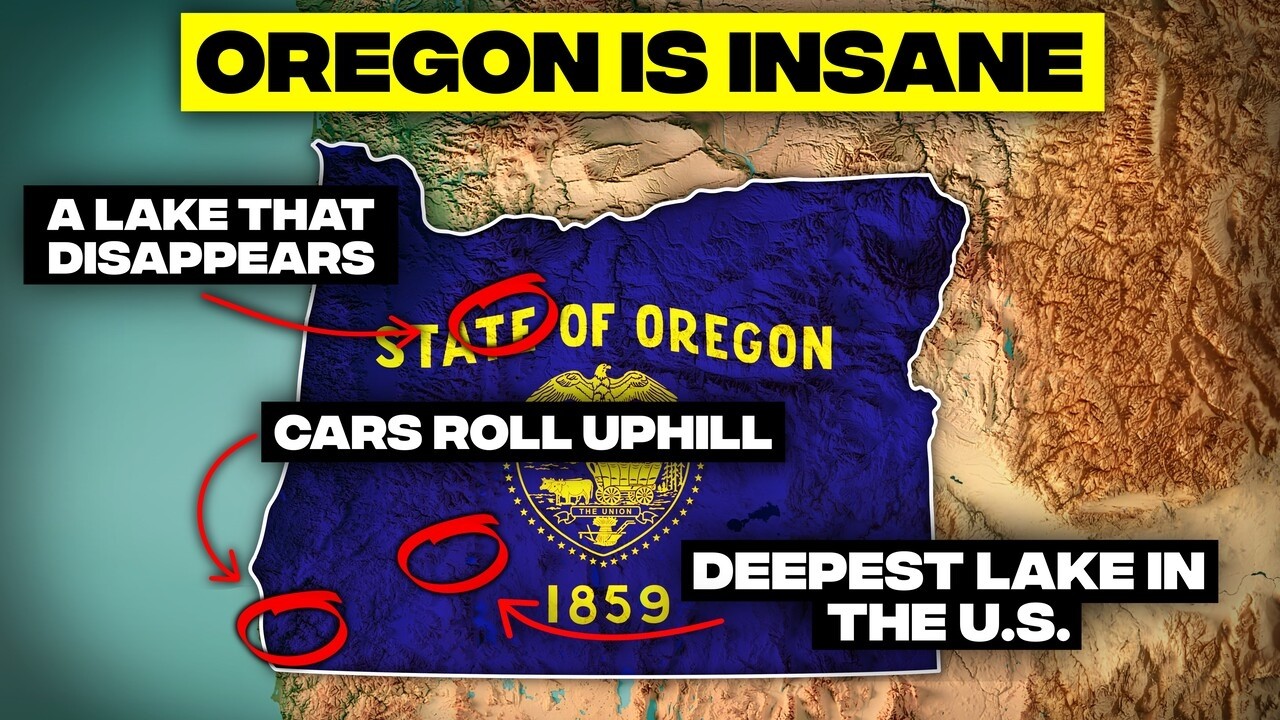
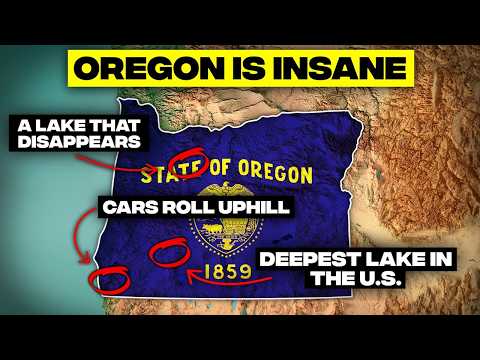
Every spring, Lost Lake near Mount Hood fills with shimmering blue water, and every summer, it completely disappears. Two massive lava tubes at its base act like drains, swallowing the entire 85-acre lake until only a grassy meadow remains. Scientists believe the water seeps through volcanic rock, resurfacing miles away as underground springs. By late summer, one can walk across the dry lake bed and peer into the gaping holes where the water goes.
Thor's Well: A natural ocean drain.
On Oregon's wild central coast, at Cape Perpetua, waves explode into a hole in the earth, creating the illusion that it is draining the entire Pacific Ocean. This is Thor's Well, a collapsed sea cave turned natural fountain of chaos. At high tide, water surges up and overflows the rim, then crashes back down with explosive force. It is only about 20 feet deep, but the visual effect is hypnotic and terrifying.
Metolius River: Bursts fully formed from a spring.
Most rivers begin as trickles, but the Metolius River defies this convention. It bursts fully formed from a spring near Black Butte, gushing over 50,000 gallons of water per minute. One moment there is forest floor, and the next, a fully-fledged river appears out of nowhere, already powerful enough for kayaking. Its steady 48°F temperature year-round comes from miles of volcanic filtration underground.
Blue Pool: A river that disappears then reappears.
In Oregon's Cascade Mountains, a section of the McKenzie River simply vanishes. When Belknap Crater erupted, lava buried 3 miles of the river. The water continued to flow, but underground. Then, without warning, it resurfaces at Tamolich Blue Pool, a turquoise basin so clear it looks artificial. With no visible inlet or outlet, this liquid sapphire bubbles straight from the earth, incredibly pure and ice cold, filtered through miles of volcanic stone.
D River: Once the world's shortest river.
Lincoln City's D River flows from Devils Lake to the Pacific Ocean, covering about 440 feet on average, though it can shrink to just 120 feet at extreme high tides. For years, it held the Guinness World Record as the world's shortest river, sparking a friendly rivalry with Montana's Roe River. While the title has bounced, locals still insist the D River deserves the crown.
Waldo Lake: Water as pure as distilled.
In Oregon's central Cascades, Waldo Lake is so clean it is nearly sterile. Fed only by rain and snowmelt, its water is purer than lab-grade distilled water, with visibility often stretching over 90 feet straight down. Fish and plants struggle to survive due to the almost complete lack of nutrients. At 420 feet deep, the lake mirrors the sky so perfectly, it appears infinite.
Willamette River: A major river that flows north.
While most major rivers flow south or east, Oregon's Willamette River flows north for 187 miles through the Willamette Valley before joining the Columbia River near Portland. This unusual direction is a result of the valley's geological formation, tilted by ancient volcanic activity and shaped by massive ice age floods. It is the lifeblood of Oregon's most populated region, supporting agriculture and industry.
Multnomah Falls: A mammoth, two-tiered cascade.
In the Columbia River Gorge, Multnomah Falls cascades 620 feet in two levels down basalt cliffs. It is the second tallest waterfall in the United States year-round. The iconic Benson Bridge, built in 1914, spans the falls at the 69-foot mark, offering spray-soaked views of the upper cascade. Fed by underground springs, it flows consistently, attracting over 2 million visitors annually.
Multnomah Creek Bridge: A historic stone structure.
The stone bridge that visitors cross to view Multnomah Falls is not just scenic, it is historic. Completed in 1914, this footbridge was designed by Italian stonemasons and is listed on the National Register of Historic Places. Officially called the Benson Bridge, it was funded by lumber baron Simon Benson to make Oregon's natural wonders accessible. It sits 105 feet above the lower cascade, offering breathtaking views.
Silver Falls State Park: Trail of Ten Falls.
Silver Falls State Park, Oregon's largest, offers the spectacular Trail of Ten Falls. This 7-mile loop passes 10 waterfalls, four of which allow you to walk behind them, immersing you in the roaring spray. South Falls, at 177 feet, is the crown jewel, where you can descend into a canyon and stand behind a curtain of water. The waterfalls carved through 15 million-year-old basalt flows.
Salt Creek Falls: Waterfall that turns to lava.
Every February at Oregon's Salt Creek Falls, the sunset aligns perfectly, causing the entire cascade to glow. For a few evenings, sunlight refracts through mist and snowmelt, making the 286-foot waterfall appear like molten lava. Photographers call it Oregon's firefall, a natural illusion of fiery orange water spilling through a frozen canyon. The effect lasts less than 10 minutes, and only if the sky is perfectly clear.
Oneonta Gorge: A living botanical museum.
Oneonta Gorge, a narrow slot canyon in the Columbia River Gorge, is carved into 25-million-year-old basalt. Its moist walls create a unique microclimate supporting over 50 species of ferns, mosses, and plants, some found nowhere else. Designated a botanical area, reaching the waterfall at its end requires wading through waist-deep water and scrambling over a logjam, a true geological and botanical adventure.
Coastal Giants and Sunken Secrets
Oregon Dunes: Inspired Frank Herbert's novel Dune.
Before Arrakis and sandworms, there were the Oregon Dunes, 40 miles of shifting desert along the coast with sand towers reaching 500 feet high. In the 1950s, writer Frank Herbert studied these dunes to understand how wind reshapes ecosystems. His observations here inspired his science fiction masterpiece, Dune, making these unreal sands the muse for one of fiction's most famous planets.
Neskowin Ghost Forest: The sea swallowed a forest.
At low tide near Neskowin, ancient tree stumps rise from the surf like tombstones. These are the remains of a 2,000-year-old Sitka spruce forest, suddenly buried by a massive Cascadia earthquake or invading dunes. When the land dropped, saltwater rushed in, and centuries later, erosion exposed the stumps. They now stand half submerged, eerie proof that the Pacific Northwest has literally sunk before.
Sea Lion Cave: America's largest sea cave.
Near Florence, Oregon, lies America's largest sea cave. Sea Lion Cave boasts a natural chamber with a domed ceiling about 125 feet high and a floor area as large as a football field. It is the only mainland rookery for Steller sea lions in the lower 48 states. Hundreds of sea lions haul out here year-round, drawn to the cave formed over millions of years by waves carving into coastal cliffs.
Astoria-Megler Bridge: Longest continuous truss in North America.
Spanning the mouth of the Columbia River, the Astoria-Megler Bridge is the longest continuous truss bridge in North America. Opened in 1966, it stretches over 4 miles and replaced the ferry service across the treacherous river mouth. Rising 196 feet above the water, it allows massive cargo ships to pass beneath, becoming an iconic landmark that has appeared in films like The Goonies.
Tillamook Rock Lighthouse: Known as Terrible Tilly.
A mile offshore from Tillamook Head sits one of the most treacherous lighthouse locations ever built. Construction began in 1878 on a wave-battered basalt rock, and danger struck immediately when a master mason was swept into the sea. Nicknamed Terrible Tilly, it operated from 1881 to 1957. In 1934, a storm threw a 135-pound rock through its lantern room, extinguishing the light. Today, it stands abandoned, a haunting reminder of the Pacific's fury.
Haystack Rock: An iconic 235-foot sea stack.
Haystack Rock at Cannon Beach is an iconic 235-foot basalt monolith. At low tide, visitors can walk right up to it, exploring tide pools teeming with sea stars, anemones, and hermit crabs. Tufted puffins nest on its slopes from April to August, making it one of the most photographed landmarks on the Oregon coast. The rock formed millions of years ago from ancient lava flows and has been protected as a marine garden since 1968.
Exploding Whale: The infamous 1970 carcass disposal.
On November 12, 1970, an 8-ton, 45-foot sperm whale washed up dead near Florence. Highway engineers decided the best disposal solution was half a ton of dynamite. The explosion was massive, raining chunks of whale blubber on spectators and cars a quarter mile away. One piece famously crushed a car's roof. The incident became legend, spawning a viral video decades later.
Glass Beach: Shipwrecks turned into gemstones.
Along the southern Oregon coast near Port Orford, a small cove known as Glass Beach sparkles with millions of tiny, polished sea glass pebbles. Emerald, amber, cobalt, and clear pieces are formed from decades of broken bottles, shipwreck debris, and storm-tossed glass. Each wave tumbles shards against volcanic rock until they round into smooth gems. Some pieces are over 100 years old, remnants of Oregon's rough maritime past.
Cascadia 1700 Megathrust Quake: An orphan tsunami.
On January 26, 1700, the Cascadia subduction zone unleashed a catastrophic earthquake, likely measuring between 8.7 and 9.2. It generated a tsunami that struck the Pacific Northwest coast and was recorded in Japanese historical documents as an "orphan tsunami" (waves without a felt earthquake). Geologists know the date precisely from these records and tree ring evidence from drowned coastal forests, a sobering reminder of the zone's active nature.
Coastal Ghost Forests: Evidence of ancient megaquakes.
All along Oregon's coast, eerie evidence of the Cascadia Subduction Zone's violent past exists in submerged forests. Ancient spruce and cedar stumps stand in estuaries and tidal zones, drowned when massive earthquakes caused the land to suddenly drop or tsunamis flooded the coast. These ghost forests are haunting reminders that "the big one" is not a matter of if, but when. Scientists can date these forests with precision by examining tree rings, with some over 2,000 years old.
Chunks of whale blubber rained down on spectators and cars a quarter mile away, with one piece famously crushing a car's roof.
Majestic Peaks and Alpine Wonders
Wallowa Lake: Behind ancient glacial moraines.
In Oregon's far northeast, Wallowa Lake is hemmed in by 900-foot glacial moraines, not man-made dams, but ancient walls of rock built by ice. Formed about 17,000 years ago, this deep blue ribbon plunges nearly 300 feet and mirrors the jagged "Alps of Oregon." Every layer of gravel and dirt was left behind by retreating glaciers, a frozen artist's signature that shaped one of the state's most jaw-dropping environments.
Alvord Desert: Made by three rain shadows.
At the base of Steens Mountain lies the Alvord Desert, 12 miles of cracked white clay where mirages ripple in the heat. It receives barely 7 inches of rain a year, thanks to a triple barrier: the Coast Range, the Cascades, and Steens itself. These three mountain ranges dry the sky before any storm arrives, leaving an alien salt flat where drivers chase land speed records and the air shimmers like another planet.
Wallowa Mountains: Known as Oregon's Alps.
The Wallowa Mountains in northeastern Oregon rise so dramatically they have earned the nickname "Alps of Oregon." These granite peaks stretch 40 miles and include some of the state's most rugged terrain, with several summits topping 9,000 feet. Much of the range is protected within the Eagle Cap Wilderness, where glacial lakes, alpine meadows, and jagged peaks create a landscape more akin to Switzerland than the Pacific Northwest.
Oregon Caves: A marble maze beneath the forest.
Deep in the Siskiyou Mountains near Cave Junction lies a hidden underworld. The Oregon Caves National Monument is a huge marble cave system carved by acidic groundwater over hundreds of thousands of years. Discovered in 1874, the caves stretch for more than 15,000 feet through twisting corridors, shimmering calcite formations, and echoing chambers. The temperature inside stays around 44°F year-round, earning it the nickname "The Marble Halls of Oregon."
Crater Lake's Old Man: A log that refuses to sink.
Crater Lake has a celebrity: a 30-foot hemlock log known as the Old Man of the Lake. It has been floating upright since 1896, calmly drifting with the wind like a wooden periscope. In a single day, it can travel more than a mile, perfectly balanced despite centuries of soaking. Carbon dating shows the tree is over 450 years old. Rangers joke it brings luck, especially after a submarine mission once anchored it, causing an immediate snowstorm.
Crater Lake: The deepest lake in the United States.
Crater Lake is the deepest lake in America, plunging to an astonishing 1,943 feet (592 meters). Formed when Mount Mazama collapsed about 7,700 years ago, the caldera gradually filled with rain and snowmelt. With no rivers flowing in or out, the water achieves absurd purity and clarity, often exceeding 100 feet of visibility. Its cobalt blue color is so intense it almost looks unreal, holding 4.6 trillion gallons of water.
The Unseen and Unbelievable
Oregon Vortex: Where physics takes a break.
Outside Gold Hill, gravity seems to defy logic. Balls roll uphill, brooms balance by themselves, and visitors appear to change height depending on their stance. The Oregon Vortex baffled early travelers and was sacred ground to the Takelma people. Scientists attribute it to an optical illusion, where tilted floors and warped horizons trick the brain. Yet, whether it is physics or paranormal marketing, everyone leaves questioning what they just saw in this "House of Mystery."
Humongous Fungus: Earth's largest organism.
Forget blue whales, the largest living organism on the planet is a fungus in Oregon's Malheur National Forest. This Armillaria ostoyae, or honey mushroom, spreads across 2,385 acres, weighs an estimated 35,000 tons, and may be over 8,600 years old. Scientists discovered it by tracking trees killed by the fungus and finding they were all connected to the same massive organism beneath the soil.
Erratic Rock: A boulder that rode an iceberg.
High above Oregon's Willamette Valley sits a 40-ton rock that should not be there. This glacial erratic drifted all the way from Idaho or Montana, carried on an iceberg during the ice age floods. When the ice melted, the boulder was dropped on a lonely hillside, like a lost package from the Pleistocene. Today, it is protected as Erratic Rock State Natural Site, a monument to a time when the Northwest was an inland sea of ice and chaos.
Willamette Meteorite: A sacred, glacial-moved space rock.
The Willamette Meteorite is a 15.5-ton iron, nickel beast covered in distinctive bowl-shaped pits. It is the largest meteorite ever found in the United States and the sixth largest in the world. Scientists believe it fell in Canada or Montana and was carried to Oregon's Willamette Valley by ice age glaciers or floods. The Clackamas people considered it sacred for centuries before a settler found it in 1902.
Mill Ends Park: The world's smallest park.
Oregon holds a unique distinction: the world's smallest park. In 1971, Guinness World Records confirmed that Portland's Mill Ends Park, measuring just 2 feet in diameter and housing a single tree, is an official city park. Originally intended for a light pole that was never installed, Oregon Journal columnist Dick Fagan planted flowers there and wrote columns about it being home to leprechauns. After Fagan's death in 1969, the city officially designated it a park.
Echoes of Human History
Heppner Flood: Oregon's deadliest natural disaster.
On June 14, 1903, the quiet town of Heppner was erased in minutes. A sudden cloudburst broke a makeshift dam on Willow Creek, unleashing a 40-foot wall of water that tore through downtown. Nearly a third of the town's population, 247 people, were killed, making it the deadliest disaster in Oregon's history. Heppner rebuilt on higher ground, but the hillside memorial still whispers the truth: the storm lasted 10 minutes, the scars are visible 120 years later.
Vanport Flood: Wiped out Oregon's second largest city.
On Memorial Day 1948, a Columbia River dike failed, leading to catastrophe. Vanport, a wartime housing city between Portland and Vancouver that had grown to over 40,000 residents, was underwater within minutes. The flood left 18,000 people homeless and killed at least 15, though some believe the actual death toll was higher. Vanport was never rebuilt, and today only historical markers hint at the city that vanished in a day.
1984 Bioterror Attack: America's largest.
In 1984, 751 people in The Dalles, Oregon, suffered food poisoning in what remains the largest bioterror attack in American history. Followers of spiritual leader Rajneesh deliberately contaminated salad bars at 10 local restaurants with salmonella to swing a county election. Though no one died, dozens were hospitalized. A year-long investigation uncovered vials of salmonella in the commune's lab, leading to convictions and changing how public health officials respond to suspicious outbreaks.
Oregon Ghost Towns: Stories of boom and bust.
Oregon is thick with ghost towns, remnants of mining camps, logging settlements, and frontier dreams that faded as quickly as they began. The Oregon Gold Rush in the 1850s spawned many such towns, most of which folded within decades when resources ran dry. Take Golden, a mining town that bloomed in the mid-1800s. Unlike typical rowdy camps, Golden was unusually civilized, boasting two churches. It thrived until the 1920s when gold reserves petered out. Today, a deserted church still stands alongside a weathered schoolhouse, frozen in time, among over 80 documented ghost towns.
Oregon's landscape serves as a grand, unfolding narrative, a series of geological plot twists and natural phenomena that challenge our understanding of the familiar. It is a vivid testament to the idea that the Earth is a living, breathing entity, constantly reshaping itself in ways both subtle and dramatic. Far from the neat diagrams of school atlases, the Beaver State reveals a world brimming with unexpected wonders, where the ground can literally crack open, mountains tilt on their sides, and the very concept of "normal" is playfully, beautifully, and sometimes terrifyingly, redefined.